
Most Effective Treatment for Phobias: Exposure Therapy, CBT & VRET | Providence
Therapy for Phobia: What's the Most Effective Treatment? Evidence-Based Options Explained
A phobia is an intense, irrational fear of a specific object, situation, or activity that disrupts daily life. According to the National Institute of Mental Health (NIMH), phobias are among the most common mental health conditions, affecting millions of people each year. If you have a phobia—whether it’s an intense fear of heights, spiders, flying, or needles—you know how much it can control your choices. These are examples of specific fears, which can vary widely from person to person and significantly impact daily routines and quality of life. You might avoid entire situations just to prevent encountering your feared object or situation. Maybe you’ve turned down job opportunities that require flying, skipped important medical procedures, or declined social invitations because of your phobia. The avoidance seems to help in the moment, but it also reinforces the fear and limits your life.

The good news: phobias are among the most treatable anxiety disorders, with highly effective treatments available. Phobias are a type of anxiety disorder that can cause significant distress and impairment in daily functioning. Research consistently shows that specific phobias respond well to therapy for phobia, with about 80-90% of people showing complete remission from phobias after a short course of cognitive behavioral therapy (CBT). Unlike many mental health conditions that require ongoing management, phobias can often be successfully treated relatively quickly.
This guide explains the most effective treatment options for phobias, what the research shows about their effectiveness, and how to choose the approach that fits your needs.
What Are Specific Phobias and How Common Are They?
About 12.5% of U.S. adults will experience a phobia at some point in their lives. Women are twice as likely to have specific phobias compared to men. Phobias are often diagnosed when the anxiety triggered by the feared stimulus becomes so intense that it causes significant distress and interferes with your daily life.
The most common categories of phobias include:
Animal phobias: Fear of spiders, dogs, snakes, or other creatures
Natural environment phobias: Fear of heights, storms, water
Blood-injection-injury phobias: Fear of needles, blood, or medical procedures
Situational phobias: Fear of flying, enclosed spaces, driving, or public transportation
The origins of specific phobias can stem from a combination of genetic, environmental, and psychological factors. Sometimes phobias develop after a traumatic event, but not always—many people develop phobias without any clear triggering experience.
Here's a concerning reality: Only 10% to 25% of affected individuals eventually receive treatment, possibly because avoidance can reduce stress and impairment in the short term. But avoidance behaviors also maintain the phobia and prevent you from living fully.
Understanding Phobia Symptoms
Phobia symptoms can whip up intense reactions in many ways, often stirring up significant distress and hijacking your daily life. If you're wrestling with a specific phobia, you might notice wall-to-wall fear or anxiety whenever you bump into—or even think about—that dreaded object or situation. These reactions aren't just "in your head"—they're real, physical storms that can trigger a racing heartbeat, sweating, trembling, or even shortness of breath. The psychological symptoms hit just as hard, churning up persistent negative thought loops, overwhelming dread, and powerful avoidance patterns that keep you steering clear of your fears.
A mental health professional can help you unpack and understand these phobia symptoms, working alongside you to craft a treatment plan tailored specifically to your needs. Treating phobias often involves exposure therapy—where you gradually and safely face your fears in a controlled setting, cooling down that anxiety response over time. Cognitive behavioral therapy (CBT) is another highly effective approach, helping you challenge those irrational thoughts and pick up fresh coping skills. Relaxation techniques—think deep breathing or progressive muscle relaxation—can also help you manage both the physical and psychological waves of symptoms.
If your phobia is stirring up significant distress or putting limits on your daily life, reaching out for help is a powerful first step—and a smart one. With the right support and evidence-based treatment, it's absolutely possible to dial down that anxiety, shift those negative thought patterns, and regain control over your life. Prioritizing your mental healthisn't retreat; it's strategy.
Types of Phobias
Phobias show up in several distinct forms—each carrying its own unique challenges and treatment needs that you'll want to understand. The most common? Specific phobias, which involve an intense, often overwhelming fear of a particular object or situation—think spiders lurking in corners, dizzying heights, or that queasy feeling when you're buckled into an airplane seat. Social phobia—also called social anxiety disorder—centers on a deep-seated fear of being judged or publicly embarrassed in social or performance situations, leading people to skip gatherings, dodge meetings, or break into a cold sweat at the mere thought of public speaking. Then there are situational phobias, tied to specific scenarios that might seem ordinary to others—driving on highways, flying cross-country, or finding yourself trapped in an enclosed space where the walls feel like they're closing in.
Understanding which type of phobia you're dealing with matters—and we mean really matters—because it helps both you and your mental health professional craft an effective treatment plan that actually works for your specific situation. Cognitive behavioral therapy (CBT), often paired with exposure therapy, stands as a proven, evidence-based approach for tackling all types of phobias. Here's how it works: CBT helps you identify and rewire those negative thought patterns and avoidance behaviors that keep your fear running the show, while exposure therapy allows you to gradually—and we do mean gradually—face the feared object or situation in a safe, supportive environment where you're never pushed beyond what you can handle.
No matter which type of phobia has been running interference in your life, effective treatment is absolutely available—and that's not just therapeutic optimism talking. By recognizing your specific challenges and partnering with a qualified therapist who gets it, you can take meaningful, concrete steps toward overcoming your fear and significantly improvingyour overall mental health and quality of life.
What is Exposure Therapy and Why is it the Gold Standard?
Exposure therapy is the gold standard treatment for specific phobias. If you consult a mental health professional about your phobia, they’ll likely recommend exposure therapy—and for good reason. It has the strongest research support of any phobia treatment for treating phobias.
How exposure therapy works: Rather than avoiding what you fear, you gradually and systematically face it in a safe, controlled environment with your therapist’s support. Exposure therapy is an evidence-based approach used to treat anxiety disorders, including phobias, by helping individuals confront and reduce their fears through structured, gradual exposure and cognitive restructuring. This process, called gradual exposure or systematic desensitization, helps your brain learn that the feared object or situation is actually safe. Structured techniques are used in therapy to break the cycle of avoidance that reinforces fear.
Why exposure works so powerfully: When you avoid something you fear, your anxiety and intense anxiety decrease temporarily—which feels like relief. But this actually teaches your brain that the thing you avoided was truly dangerous. Exposure therapy breaks this cycle. By staying with the feared situation until your anxiety naturally decreases (without escaping or using safety behaviors), you learn that:
The feared outcome you’re worried about doesn’t actually happen
You can tolerate the uncomfortable feelings of anxiety
Anxiety naturally decreases over time, even without avoidance
Types of Exposure Therapy
Exposure therapy comes in different formats, all effective:
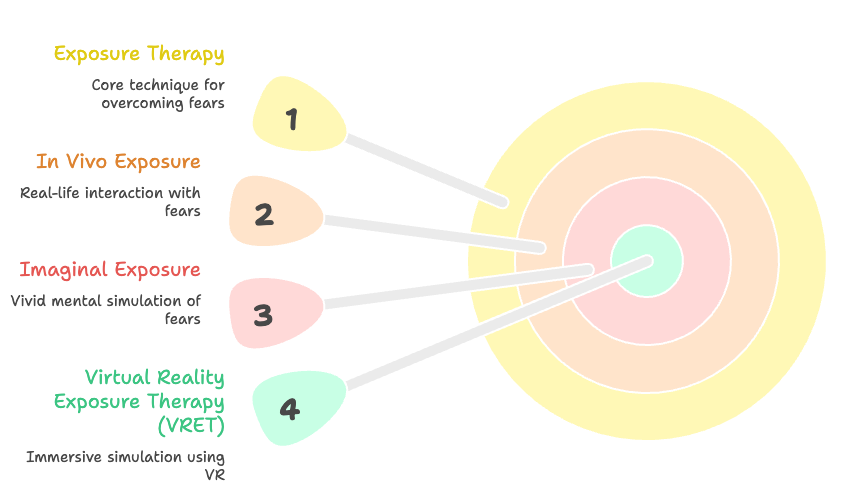
In vivo exposure: Direct, real-life contact with the feared object or situation. If you have a fear of dogs, this means actually being around dogs in real life, starting with less intimidating situations (looking at pictures) and gradually working up to more challenging ones (petting a calm dog).
Imaginal exposure: Vividly imagining the feared situation while describing it aloud. This can be useful when in vivo exposure isn't practical or as a stepping stone before real-life exposure.
Virtual reality exposure therapy (VRET): Using virtual reality technology to simulate the feared situation in a safe, controlled way. We'll discuss this more below.
How Effective is Exposure Therapy?
Research shows that exposure therapy produces large effect sizes for specific phobias. Exposure therapy is a primary method used to treat specific phobias, helping individuals gradually confront and overcome their irrational fears. A comprehensive meta-analysis found that exposure-based treatment outperformed both placebo conditions and alternative psychotherapeutic approaches.
Important finding: In vivo exposure outperformed alternative modes of exposure at post-treatment but not at follow-up. This means that while direct real-life exposure might work slightly faster, all formats of repeated exposure produce similar long-term results.
The effectiveness of exposure therapy doesn’t vary by type of specific phobia—whether you have a fear of animals, heights, enclosed spaces, flying, or medical procedures, exposure therapy works across all categories.
In our work with clients at the Providence Therapy Group, we’ve found that understanding how exposure works helps people commit to the process, even when it feels counterintuitive. Many clients tell us their first reaction is “Wait, you want me to do the thing I’m most afraid of?” But when they understand that avoidance maintains the phobia and exposure breaks that cycle, they’re willing to try. We see remarkable transformations when people discover they can tolerate the anxiety and that their feared outcomes don’t actually happen.
Can Phobias Be Treated in Just One Session?
This might surprise you: research shows that single-session exposure therapy can be an effective treatment for specific phobias.
One-Session Treatment (OST) is considered a well-established evidence-based treatment for specific phobias. During a single extended session (typically 2-3 hours), you work intensively with a therapist using graduated exposure. Graded exposure involves creating a 'fear ladder' that progresses from the least scary to the most intense exposures, and you move systematically up this hierarchy.
OST incorporates several elements:
Psychoeducation about fear and anxiety
Cognitive challenges to irrational thoughts associated with the phobia
Modeling (therapist demonstrates approaching the feared object)
Gradual, structured exposure
Skills training and reinforcement
How Effective is Single-Session Treatment?
A meta-analysis comparing single-session and multi-session exposure therapy found no significant differences in effectiveness at post-treatment or follow-up. Both approaches produced large effect sizes for all outcomes. However, single-session exposure required significantly less total treatment time, making it more time-efficient without sacrificing effectiveness.
This has been confirmed even in children and adolescents. A large randomized trial with 268 young people found that One-Session Treatment was non-inferior to multi-session CBT for specific phobias, with similar outcomes at 6-month follow-up and lower service costs.
What this means practically: You don't necessarily need months of weekly therapy to overcome a phobia. For many people with specific phobias, a single intensive session can produce lasting results. However, single-session treatment requires committing to several hours of intensive exposure work in one day, which isn't the right fit for everyone.
We often tell clients that single-session treatment isn't right for everyone, but when it works, it's incredibly efficient. Some people do better with the intensive, "rip the bandaid off" approach rather than spreading exposure over weeks. Others need the gradual progression of multi-session therapy to build confidence. What matters most is finding an approach that matches your preferences and circumstances. Both formats have strong research support—there's no wrong choice, just different paths to the same destination.
What is Virtual Reality Exposure Therapy (VRET)?
Virtual reality exposure therapy uses VR technology to create realistic simulations of feared situations. You wear a VR headset and experience immersive scenarios—standing on a virtual tall building if you fear heights, or sitting in a virtual airplane if you fear flying—all from the safety of your therapist's office.
How Effective is VRET Compared to Traditional Exposure?
The research on virtual reality therapy is remarkably strong. A meta-analysis found that VRET produced large effect sizes versus waitlist and medium-to-large effect sizes versus psychological placebo. Most importantly, comparison of VRET and in vivo exposure showed no significant difference in effectiveness, indicating they're equivalent treatments.
Another meta-analysis specifically comparing virtual reality exposure to in vivo exposure found no evidence that VRET is significantly less efficacious than in vivo exposure for specific phobia.
Benefits of VRET
Safety and control: For phobias involving potentially dangerous situations (like heights or driving), VRET allows repeated exposure without any actual threat or risk.
Accessibility: Some feared situations are hard to access for traditional exposure therapy. It's easier to simulate flying in virtual reality than to book multiple flights for exposure purposes.
Graduated control: The therapist can precisely control the intensity of exposure, gradually increasing difficulty.
Cost-effectiveness: Recent research demonstrates that fully self-guided VR CBT apps delivered through smartphones with basic cardboard VR goggles can be effective for phobias like fear of heights, with treatment gains maintained at 3-month follow-up. This suggests VRET could become increasingly accessible without requiring expensive equipment or therapist time.
What Phobias Can VRET Treat?
VRET has been shown effective for agoraphobia, social phobia, and specific phobias. Research suggests that for agoraphobia and social phobia, VRET is effective when performed over 8-12 sessions, approximately once weekly, for at least 15 minutes. For specific phobias, treatment is effective even as a single longer session lasting 45-180 minutes.
What About Cognitive Behavioral Therapy (CBT) for Phobias?
Cognitive Behavioral Therapy (CBT) is the most effective treatment for phobias, particularly when it incorporates exposure therapy. CBT is a form of talk therapy that helps you identify and challenge the irrational thoughts associated with your phobia while also using behavioral techniques (exposure) to change your fear response.
How CBT works for phobias:
Cognitive restructuring: You learn to identify negative thought patterns—such as negative thoughts that catastrophize or overestimate danger—and challenge them. For example, if you have a fear of flying, you might believe “If there’s any turbulence, the plane will crash.” CBT helps you examine the evidence for this thought and replace it with more realistic thinking. CBT helps individuals recognize how these negative thoughts create and maintain their fear, and teaches strategies to replace them with healthier perspectives.
Behavioral experiments: You test your fears through exposure to see what actually happens, gathering evidence that contradicts your catastrophic predictions.
Systematic desensitization: Often incorporated into cognitive behavioural therapy, this involves gradual exposure combined with relaxation techniques and deep relaxation to manage physical symptoms and psychological symptoms during the process.
Acceptance and Commitment Therapy (ACT) is another effective approach for therapy for phobia. ACT helps individuals accept difficult emotions related to their phobia and commit to actions that are aligned with their values, rather than avoiding feared situations.
Mindfulness techniques can also be used alongside CBT to help reduce anxiety and the level of stress experienced during phobia encounters. Integrating mindfulness into treatment supports emotional regulation and resilience, contributing to improved mental well being and a more balanced state of mind as you recover from phobias.
How Effective is CBT for Social Phobia?
While exposure therapy is the gold standard for most specific phobias, CBT is established as first-line treatment for social anxiety disorder (social phobia). In high-quality studies, response rates for CBT were 50% to 65%, superior to placebo (32%) and waitlist controls (7-15%).
Long-term research shows that CBT benefits persist beyond the treatment period. At 12 months or more after treatment, people who received CBT for social phobia showed continued improvement in social anxiety and quality of life, with maintained gains in depression and general anxiety.
What About Treatment for Blood-Injection-Injury Phobia?
Blood-injection-injury (BII) phobia is unique among phobias because it often involves fainting. When people with BII phobia encounter blood, needles, or medical procedures, their blood pressure drops and heart rate slows (vasovagal response), which can lead to fainting.
Applied Tension is the recommended treatment specifically for BII phobia. Applied tension is a tension technique combined with in vivo exposure designed to counteract the unique vasovagal response seen in this type of phobia.
How applied tension works: You learn to tense the muscles in your arms, chest, and legs when encountering blood or medical situations. This prevents blood pressure from dropping and helps you avoid fainting while you gradually face your fear.
Research shows that applied tension is effective for reducing fainting compared to exposure alone, both immediately after treatment and at one-year follow-up. Newer research has found that brief, video-based instructions in muscle tension techniques can be effective with minimal time and expertise required.
Are There Medications That Help with Phobia Treatment?
While therapy is the best treatment for phobias, some medications may enhance therapy outcomes when used as augmentation.
D-cycloserine (DCS) is a medication that has been studied as an augmentation strategy for exposure therapy. Research shows that DCS provides a small but significant augmentation effect when combined with exposure-based therapy, with an effect size of d=-0.25 at post-treatment.
DCS appears most effective when administered at low doses close to exposure therapy sessions. It may be particularly valuable for people with severe anxiety or severe cases of phobias that haven't responded well to conventional treatments.
Beta-blockers are sometimes used to manage the physical symptoms of anxiety in specific situations (like public speaking for social phobia), though they don't treat the underlying phobia. Beta blockers can help reduce symptoms like rapid heartbeat and trembling.
Important note: Medication alone is not typically recommended as the primary treatment for phobias. Pharmacotherapy alone is not a common treatment choice for specific phobias. The most effective treatment for phobias is exposure-based therapy, with medication potentially playing a supporting role in some cases for certain mental health conditions.
Managing Physical Symptoms
The physical symptoms of phobias—that pounding heart, the sweating, shaking, or feeling like you might just float away—can feel like being caught in a storm you didn't see coming. These overwhelming sensations don't just sit there quietly; they amplify your anxiety and can make you feel like you're losing control of your own body. But here's the thing: learning to navigate these choppy physical waters is absolutely central to phobia treatment—and it can help you regain your footing when anxiety tries to steer the ship.
Relaxation techniques work like anchors in these moments. Deep breathing exercises, progressive muscle relaxation, and guided visualization—these aren't just feel-good suggestions, they're evidence-based tools that can genuinely calm your body's stress response and dial down that anxiety dial. And let's talk lifestyle: making healthy choices like regular exercise, balanced nutrition (yes, what you eat matters), and getting enough sleep supports your overall mental well-being and can actually lessen the intensity of those physical symptoms that feel so overwhelming.
Sometimes—and this is where working with a healthcare provider becomes crucial—medication like beta blockers might be recommended to help manage those physical anxiety spikes in specific situations. But here's what's important to understand: medication is usually part of a team approach, not a solo act. Cognitive behavioral therapy (CBT) and exposure therapy remain the gold-standard treatments for tackling both the physical and psychological sides of phobias, helping you build real confidence and resilience over time—the kind that sticks.
By practicing these strategies and partnering with a mental health professional (someone who gets it), you can reduce the grip those physical symptoms have on you and take meaningful steps toward overcoming your phobia. It's not about perfection—it's about reclaiming your sense of control and learning that you can weather these storms.
How Do I Choose Which Treatment is Right for Me?
With several evidence-based options available for treating phobias, how do you decide which phobia treatment to pursue?
Consider exposure therapy (multi-session) if:
You want the treatment with the strongest research support
You prefer gradual progression over several weeks
You need time to build confidence and learn coping skills between sessions
You have multiple phobias or complex anxiety disorders
Consider single-session treatment (OST) if:
You have a specific phobia (rather than social phobia or agoraphobia)
You want the most time-efficient option
You can commit to a single extended (2-3 hour) intensive session
You want to overcome your phobia quickly
Consider virtual reality exposure therapy (VRET) if:
Your phobia involves situations that are difficult or expensive to access (flying, heights)
You want very gradual, controlled exposure
You're interested in technology-based approaches
You want to practice exposure in a completely safe environment
Consider CBT with exposure if: You’re interested in a relationship-based therapy approach that emphasizes trust, emotional expression, and lasting change.
You have social phobia (social anxiety disorder) or panic disorder
You want to address both thought patterns and behaviors
You'd benefit from cognitive restructuring along with exposure
You want a structured, comprehensive approach
Consider applied tension if:
You have blood-injection-injury phobia
You experience fainting or near-fainting with your phobia
You need techniques specifically designed for the vasovagal response
Finding the right therapist matters: The relationship between a client and their therapist is incredibly important for treatment outcomes. When looking for the right therapist, consider your preferences about communication style, cultural awareness, and approach to treatment.
The reality is you don't have to choose alone. When you meet with a mental health professional, they'll assess your specific phobia symptoms, phobia treatment history, and personal preferences to recommend the most appropriate treatment plan.
From a clinical perspective, we see successful outcomes across all these treatment approaches when clients are engaged in the process. The research confirms what we observe in practice: exposure therapy works regardless of format—whether in vivo, virtual reality, or single-session. What predicts success isn't which specific approach you choose, but rather your willingness to face your fear systematically and your trust in the therapist guiding you. We work collaboratively to find the approach that feels doable for you.
Finding the Right Therapist
Finding the right therapist is like navigating a crucial crossroads in your journey to kick phobias to the curb. A mental health professional who's got real experience wrestling with anxiety disorders and phobias can offer the guidance, support, and evidence-based strategies you need for lasting change that actually sticks. When you're hunting for a therapist, zero in on their training in cognitive behavioral therapy (CBT) and exposure therapy—these are among the heavyweight champions of phobia treatment (and for good reason).
It's also key to find someone who feels right—someone who really listens, gets your concerns, and respects your unique background and what makes you tick. Don't hesitate to grill potential therapists about their phobia-fighting experience, their therapeutic approach, and how they craft a treatment plan that's tailored specifically to your needs. Questions like, "What's your track record with treating phobias?" or "How do you weave exposure therapy into your practice?" can help you separate the wheat from the chaff and find the right therapeutic match.
With the right therapeutic relationship—one that clicks—and a personalized treatment plan, you can make real, meaningful headway in conquering phobias and boosting your mental health game. Remember, reaching out for help isn't weakness; it's actually a sign of serious strength—and the first step toward reclaiming your life from fear's grip.
What Should I Expect from Phobia Treatment?
Regardless of which type of therapy you choose, here's what to expect from treatment for phobias:
Assessment: Your therapist will evaluate your phobia symptoms, how they affect your daily life, when the fear started, what you've tried before, and your goals for treatment.
Fear hierarchy: Together, you'll create a "fear ladder"—a ranked list of situations related to your phobia, from least to most anxiety-provoking. This guides the gradual exposure process.
Active participation: Phobia treatment requires you to face your fears, which can feel uncomfortable initially. The discomfort is temporary and part of how treatment works.
Practice between sessions: You'll likely be asked to practice exposure exercises at home between therapy sessions to reinforce what you're learning.
Monitoring progress: Your therapist will track your progress using objective measures to ensure treatment is working and symptoms are decreasing.
Common timeline: Many people notice significant improvement within a few sessions, though the exact timeline varies. Single-session treatment works in one extended session, while traditional exposure therapy might take 6-12 sessions. VRET for specific phobias can be effective in a single 45-180 minute session.
Getting Started with Phobia Treatment at the Providence Therapy Group
If your phobia is interfering with your life—causing you to avoid important activities, limit your opportunities, or experience significant distress—effective treatment is available. Phobias are among the most successfully treated mental health conditions, and you don't have to continue letting fear control your choices, even during vulnerable times like pregnancy and the postpartum period when perinatal mental health challenges can arise.
At the Providence Therapy Group, our therapists specialize in evidence-based treatment for specific phobias, social phobia, and other anxiety disorders. We offer cognitive behavioral therapy and exposure-based treatments tailored to your specific phobia and goals. Many therapists offer teletherapy services for Rhode Island residents, allowing you to receive treatment from the comfort of your home if that works better for your life.
With offices in Providence and Cumberland, Rhode Island, we serve clients throughout Providence, Cranston, Edgewood, and the surrounding areas, including individuals seeking top therapists in Providence for anxiety and related concerns. We offer both in-person sessions and online and in-person therapy appointments with licensed therapists, giving you flexibility in how you access mental health care.
You don't have to live with a phobia. Research shows that treatment works, often relatively quickly. If you're ready to overcome your fear and reclaim the activities and experiences your phobia has taken from you, schedule an appointmentto discuss which phobia treatment approach might work best for you.
Disclaimer: This article is for educational purposes only and is not a substitute for professional medical advice, diagnosis, or treatment. Always seek the advice of your physician or qualified mental health provider with any questions you may have regarding a mental health condition. If you are in crisis or experiencing thoughts of self-harm, please call 988 (Suicide and Crisis Lifeline) or go to your nearest emergency room.