
What Is Pathological Demand Avoidance? A Therapist's Guide to PDA, Diagnosis, and Support in Adults

If you have spent years being called "difficult," "oppositional," or "impossible to help" — and nothing you've tried has ever quite worked — pathological demand avoidance (PDA) may be a framework worth knowing about.
PDA is not a formal diagnosis. It does not appear in the diagnostic and statistical manual published by the American Psychiatric Association, nor in any other international medical manual. But among clinicians, autism researchers, and the autism community, it describes a recognizable and often severely impairing pattern: an intense, anxiety-driven need to avoid or resist demands. Not just things you don't want to do — but often things you genuinely want to do, have chosen to do, or know you need to do.
For many adults, learning about pathological demand avoidance is a turning point. It offers a way to understand lifelong patterns that may have been attributed to laziness, defiance, or treatment resistance. At the Providence Therapy Group, we work with adults across Rhode Island — including in Providence, Cranston, and Cumberland — who are asking these questions, often for the first time.
This post covers what pathological demand avoidance is, what it looks like in adults, how it differs from other conditions, what causes it, and what kinds of support actually help.
What Is Pathological Demand Avoidance?
Pathological demand avoidance — sometimes called the PDA profile — describes a behavioral profile in which a person experiences an overwhelming, anxiety-driven need to resist or avoid everyday demands and expectations. The word "pathological" refers to the extreme and pervasive nature of the demand avoidance, not a moral judgment about the person experiencing it.
The concept was introduced by British developmental psychologist Elisabeth Newson in the 1980s to describe a group of children within the autism spectrum who showed persistent and marked resistance to ordinary demands, combined with an ability to use social strategies to evade those demands. The term pathological demand avoidance syndrome was formally published in a research paper in 2003.
Pathological demand avoidance PDA is most often described within the context of autism spectrum disorder. Most individuals identified with a PDA profile meet criteria for autism spectrum disorder on detailed diagnostic assessment, though demand avoidance behaviors can also co-occur with attention deficit hyperactivity disorder and other developmental disorders. Historically, some individuals received a pervasive developmental disorder classification before more current diagnostic frameworks were applied — and the PDA profile often went unrecognized within those assessments.
One thing to know upfront: pathological demand avoidance PDA is not a recognized diagnosis in any major clinical system — not in the diagnostic and statistical manual (DSM-5) or any other international medical manual. This creates real challenges for adults seeking an autism diagnosis or appropriate support. The PDA Society — the leading international resource — uses the term "PDA profile" to reflect this. The national autistic society similarly acknowledges demand avoidance as a significant feature in some autistic presentations, and the broader autism spectrum acknowledges demand avoidance as a distinct and meaningful pattern requiring specific clinical attention.
Whether or not the PDA label is ultimately validated as a standalone condition, the behavioral profile it describes is real, often profoundly impairing, and requires approaches that differ significantly from standard autism or behavioral strategies.
What Does Pathological Demand Avoidance Look Like in Adults?
Demand avoidance in adults is frequently missed. Adults have often spent years developing sophisticated strategies for managing — or hiding — their difficulties. Many adults with a PDA profile were never assessed as children, or received a different diagnosis: an anxiety disorder, oppositional defiant disorder, borderline personality disorder, or simply "treatment-resistant" mental disorders like depression or anxiety.
Research emerging from European child and adolescent psychiatry has highlighted that the PDA profile is particularly underidentified in autistic women, who tend to develop more elaborate masking strategies and may not receive an autism diagnosis until well into adulthood — if at all. This can be especially relevant during major life transitions such as pregnancy and the postpartum period, when specialized perinatal mental health support in Providence may be needed alongside neurodiversity-informed care.
What Counts as a "Demand"?
One of the most disorienting things about pathological demand avoidance is how broadly the word "demand" applies. For someone with a PDA profile, a demand is not simply being told to do something they dislike. It can include:
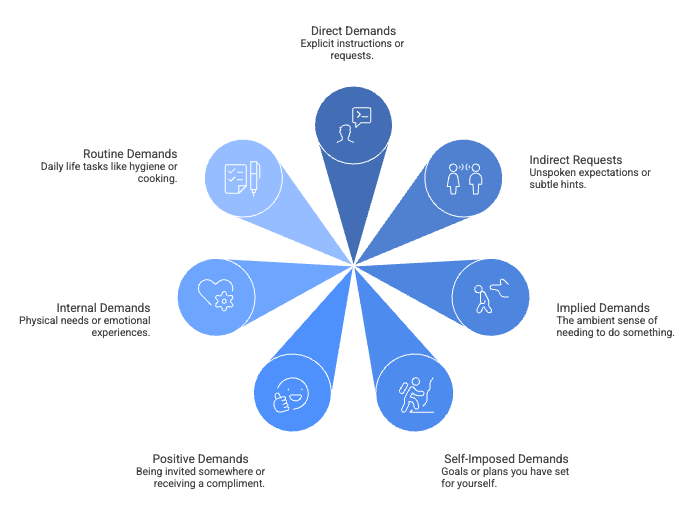
Direct demands: "Can you send that email?" or "It's time to leave."
Indirect requests: Knowing it's a workday. Feeling the unspoken expectation to reply to a message. Sensing that someone wants something from you without saying so directly.
Implied demands: The ambient sense that you "should" be doing something — even when no one has said a word.
Self-imposed demands: Goals you have set for yourself, plans you were genuinely looking forward to, written requests you've made of yourself.
Positive demands: Being invited somewhere you want to go, receiving a compliment, being offered recognition. Direct praise can itself function as a demand.
Internal demands: Physical needs like hunger or tiredness, emotional experiences, the background thought that you "should" be doing something.
Routine demands: Personal hygiene, cooking, paying bills, getting dressed — the daily life tasks most people complete on autopilot.
That last category is where confusion often deepens. Adults with demand avoidance behaviors regularly describe being unable to do things they genuinely want to do. The avoidance is not about preference. It is experienced as a perceived threat to personal autonomy — and the nervous system responds with the same urgency it would to a genuine danger.
The Autonomy Drive
A key feature of pathological demand avoidance is an intense, persistent need for personal autonomy. People with a PDA profile experience a strong internal conflict: they want to complete tasks, but feel unable to do so when those tasks register as demands — even self-chosen ones. The experience is not "I don't want to do this." It is closer to: "I cannot do this right now, and I don't fully understand why."
This drive is so central that some within the autism community prefer the term "Persistent Drive for Autonomy" over "Pathological Demand Avoidance" — arguing that the core issue is a neurological need for self-determination rather than a pathology to be corrected.
How Avoidance Shows Up in Adults
People with the PDA profile use a wide range of strategies to avoid demands. In adults, these tend to be sophisticated and socially aware, which makes pathological demand avoidance difficult to identify from the outside:
Elaborate making excuses and rationalizations
Chronic procrastination, task-switching, or simply not starting
Physical symptoms like stomachaches or headaches — which may be genuine physical manifestations of anxiety
Endless negotiating, or setting conditions before agreeing to anything
Using charm or humor to steer attention away from the demand
Withdrawing completely — going quiet, becoming unavailable, shutting down
Role play or retreat into fantasy as a way of creating psychological distance
Point blank refusal when overwhelm reaches a critical level
Explosive outbursts or panic attack responses when other strategies fail and the person feels cornered
These behaviors are not deliberate manipulation. PDA research and clinical experience consistently point to overwhelming anxiety — not willful defiance — as the driver. Understanding this reframes everything.
Mood and Emotional Profile
Adults with PDA behaviors often experience extreme mood swings: rapid, dramatic shifts from warmth and engagement to withdrawal or outburst, sometimes with little apparent trigger. PDA research has described this as a "Jekyll and Hyde" quality — the person may appear completely at ease, and then collapse into intense emotional distress the moment a demand enters the picture. Unpredictable mood swings of this kind are considered a key feature and associated symptom of the behavioral profile.
Panic attacks, shutdown states, and intense emotional distress are common when the person cannot escape a demand. These are genuine panic responses, not performances.
Beyond mood, adults with the PDA profile commonly experience:
Pervasive anxiety that is often hard to trace to specific causes
Depression and low self-esteem, frequently shaped by years of being misunderstood or punished for avoidance
Burnout following long periods of forced compliance or masking, which may make flexible online and in-person teletherapy options especially important for sustaining support
Obsessive behaviour centered on particular people or fictional characters, and in some individuals, patterns that overlap with obsessive-compulsive disorder (OCD) symptoms and treatment needs
Particular difficulty with authority figures and societal expectations
Relationship challenges tied to the intensity of the need for control
From the Therapist
When adults with a PDA profile first come to see us, they often arrive carrying years of being told they're the problem. The emotional exhaustion is real — chronic anxiety, repeated burnout, relationships strained by patterns nobody had a name for. What we find, consistently, is that the demand avoidance behaviors that look like resistance are almost always rooted in overwhelm. Reframing that — for the client and for the people around them — is often where meaningful progress begins.
What Causes PDA in Autism?
PDA research is still developing, and exact causes are not fully established. Several overlapping factors are consistently discussed by clinicians and autism researchers.
Anxiety as the Engine
There is broad clinical consensus that anxiety is the central driver of demand avoidance. Demands — even trivial ones — appear to activate a threat response in the nervous system. This is not ordinary situational anxiety about a specific fear. It is a pervasive alarm response triggered by the experience of expectation itself, regardless of how gently the demand is delivered.
Research suggests that autistic traits and anxiety are each equally important and independent predictors of extreme demand avoidance — meaning PDA behaviors appear to arise from the combination of neurodevelopmental difference and an anxiety-amplified response to perceived threats.
Intolerance of Uncertainty
A key mechanism linking autism spectrum and demand avoidance appears to be intolerance of uncertainty — difficulty tolerating situations where outcomes are unclear or the world predictable enough to feel safe. Systematic review evidence suggests that cognitive inflexibility in autism spectrum disorder leads to intolerance of uncertainty, which in turn drives both internalizing problems such as anxiety and depression, and externalizing behaviors like avoidance and outbursts.
For adults with the PDA profile, demands may represent uncertainty: "What happens if I try? What if I fail? What if something goes wrong?" That uncertainty triggers anxiety, which triggers avoidance.
The Autonomy Need as a Neurological Factor
Some autism researchers frame the autonomy drive in the PDA profile as neurological rather than psychological — a hardwired need for self-determination that, when threatened, produces an immediate avoidance response. From this perspective, what looks like defiance or social manipulation is a nervous system organized around personal autonomy in a way that makes external control genuinely intolerable.
How Is PDA Different From Other Conditions?
Understanding how pathological demand avoidance differs from similar-looking conditions is important for getting appropriate support. Misidentification is especially common in adults.

PDA vs. Autism Spectrum Without the PDA Profile
While pathological demand avoidance exists within the autism spectrum, the PDA profile looks different from more typical autism presentations:
Many autistic adults benefit from predictable routines and clear expectations. Adults with the PDA profile often find these intolerable — structure feels like a series of demands that increase anxiety rather than reduce it.
Adults with a PDA profile may appear more socially fluent than is typical in autism, using charm and social strategies to manage situations. This surface-level social ability often coexists with significant difficulty in deeper relationships and in understanding social responsibilities.
Approaches that support many autistic adults — visual schedules, consistent routines, advance warnings — are frequently counterproductive for the PDA profile, because they are experienced as additional demands.
PDA vs. Oppositional Defiant Disorder
Adults with pathological demand avoidance PDA are often misidentified with oppositional defiant disorder, particularly in adolescence and early adulthood. The two can look similar on the surface, but the mechanisms differ:
In oppositional defiant disorder, resistance is typically driven by anger and a desire to defy authority figures. In pathological demand avoidance, avoidance is driven by overwhelming anxiety and an urgent need to escape demand — not defiance.
Demand avoidance behaviors in PDA extend to self-imposed demands and things the person genuinely wants to do. Oppositional defiant disorder is directed outward, toward authority.
Behavioral and reward-based approaches that reduce oppositional defiant disorder symptoms are often ineffective for demand avoidance — or actively worsen it.
Research indicates that emotional symptoms in the PDA profile exceed those seen in both autism-only and conduct-problem groups, suggesting a distinct emotional profile. [CITATION NEEDED — European Child & Adolescent Psychiatry]
Is PDA ADHD or Autism?
This is one of the most common questions in PDA research. Pathological demand avoidance is most consistently associated with autism spectrum disorder — the vast majority of individuals identified with a PDA profile meet criteria for autism spectrum disorder on comprehensive assessment. Demand avoidance behaviors also frequently co-occur with attention deficit hyperactivity disorder and other developmental disorders. PDA is not a subtype of either condition. It is best understood as a behavioral profile that can occur within autism spectrum, ADHD, or both — characterized by extreme demand avoidance behaviors driven by anxiety and a persistent need for personal autonomy.
From the Therapist
One of the most common things we hear from adults exploring a PDA profile is: "I've been in therapy before and it didn't help." That's important information, not a reason to give up on support. Standard approaches — structured CBT, behavioral contracts, exposure hierarchies — can inadvertently increase demand load for someone with PDA. Understanding which framework fits a person's actual neurological experience is what allows us to offer something different, and more useful.
The Diagnostic Debate: What You Should Know
Pathological demand avoidance syndrome remains a contested concept in clinical and research settings, and this debate has real practical implications for adults seeking support.
Those who find the PDA framework clinically useful argue that it describes a recognizable pattern that many healthcare professionals and education professionals encounter. The PDA Society, the national autistic society, and a growing body of clinicians in the United Kingdom and Europe support PDA-informed approaches. Identifying the PDA profile has important implications for management: standard autism and behavioral strategies are often ineffective, and recognizing this directs support teams toward approaches that actually work. For many adults, the framework also helps validate PDA experiences that have long been dismissed or misattributed — providing a structure for understanding lifelong patterns previously attributed to character failings.
Those who are cautious or critical argue that the evidence does not support pathological demand avoidance as an independent syndrome. Most PDA research has relied on parent report, the perspectives of individuals with PDA themselves have rarely been studied, and the behaviors described may be better understood as autism, anxiety, and co-occurring conditions in combination. Some autism researchers also argue that the term risks pathologizing anxiety-driven behavior that is better understood through a neurodiversity lens.
A review in The Lancet concluded that while the evidence does not support PDA as an independent syndrome, the term highlights an important range of co-occurring difficulties that substantially affect many people with autism spectrum — difficulties that require specific, individualized support. Extensive research via the Routledge International Handbook also acknowledges that while the diagnostic picture remains unresolved, the practical need for PDA-informed approaches is clear.
What this means practically: Whether or not pathological demand avoidance is eventually formalized as a diagnosis, the experiences it describes are real. If this framework resonates with your experience, it can point you toward support that actually helps — regardless of what label appears on your chart.
What Actually Helps: Support for Adults With PDA
Because the PDA profile often does not respond to standard approaches, specific strategies are needed. The following are based on clinical experience, including group therapy and other supports for adults, and the best available evidence. Rigorous controlled trials specifically for PDA management in adults remain limited, and this area continues to develop.
Reduce the Overall Demand Load
The foundational principle in supporting demand avoidance is to reduce demands overall — identifying what is genuinely essential and releasing the rest, particularly during high-anxiety periods. This is not about lowering standards. It reflects a practical reality: when anxiety is elevated, even minor additional demands can cause overwhelm. When the overall load is lower, more becomes possible.
Use Indirect Language and Avoid Demand Words
Direct demands — even mild ones — can trigger avoidance. Reframing requests as observations or suggestions reduces the sense of threat:
Instead of "You need to call them back today" → "I noticed that call is still outstanding"
Instead of "Can you finish this?" → "I wonder what it would take to get that wrapped up"
Offering information rather than instructions gives the person a genuine sense of choice and reduces the experience of being controlled. Indirect requests, used consistently, can make a significant practical difference.
Offer Real Autonomy and Choice
Adults with the PDA profile respond better when they have genuine input into how, when, and in what order things happen. Collaborative problem-solving — "How do you want to approach this?" or suggest ideas together rather than issuing directives — is consistently more effective than top-down communication. This is not about giving in to everything. It is about working with the person's autonomy drive rather than against it.
Use Humor, Novelty, and Flexibility
Clinical accounts of the PDA profile consistently describe humor, playfulness, and novelty as effective social strategies. Varying your approach, making tasks feel like choices rather than expectations, and staying flexible can bypass the demand avoidance response in ways that direct communication simply cannot. Remaining calm — particularly during high-anxiety moments — also matters: the person's ability to regulate is closely tied to the emotional tone around them.
What Tends Not to Work
For adults with PDA behaviors, the following approaches are generally ineffective or counterproductive:
Rigid schedules, accountability systems, or routine tasks structured as non-negotiable — experienced as demands
Reward schemes or incentive-based systems — the reward becomes a demand
Ultimatums and consequences — increase anxiety, damage trust, and escalate extreme resistance
Insistence and confrontation during high-anxiety states
Exposure therapy without significant modification — the therapeutic process itself involves demands that can trigger avoidance, and even structured modalities like Dialectical Behavior Therapy (DBT) may need careful adaptation to avoid increasing demand load
Therapy With a PDA-Aware Clinician
Therapy can be genuinely useful for adults with pathological demand avoidance PDA, but the therapeutic relationship must be low-demand and flexible. Traditional Cognitive Behavioral Therapy (CBT) approaches often require adaptation, as session structure and between-session tasks can themselves trigger avoidance. Neurodiversity-affirming therapy that prioritizes the therapeutic relationship, collaborative goal-setting, and appropriate support for the client's personal autonomy tends to be more effective.
At the Providence Therapy Group, our therapists work with adults in Providence, Cranston, Edgewood, and across Rhode Island who are seeking personalized, relationship-based therapy for demand avoidance, autism spectrum differences, and anxiety — including those who are still working out what framework best fits their experience.
From the Therapist
Working with adults who have a PDA profile requires us to hold our own clinical expectations loosely. We've found that the most effective sessions are often the ones with the least agenda — where the client has genuine input into what we focus on, how fast we move, and what "progress" looks like for them. Autonomy isn't just something we discuss in session; it's something we build into the therapeutic relationship from the start. That shift alone changes what's possible.
Getting Appropriate Support
If the pathological demand avoidance profile resonates with your experience, here are practical next steps for finding an individual therapist in Providence:
Seek a comprehensive assessment that considers autism spectrum disorder, anxiety, ADHD, and other developmental disorders — rather than looking for a standalone PDA diagnosis, which does not currently exist in major diagnostic systems. You can schedule an online or in-person therapy appointment with a licensed clinician to begin this process.
Look for clinicians familiar with demand avoidance. Ask directly about experience with the PDA profile and whether they work with flexible, low-demand approaches.
Connect with the PDA Society and the national autistic society for resources, community, and guidance on accessing appropriate support.
Be honest about what hasn't worked. A long history of failed treatments is not evidence of inadequacy. For many adults with the PDA profile, prior approaches were simply not designed for how their nervous system functions.
Final Thoughts
Pathological demand avoidance describes a real pattern of experience — one that remains underrecognized in adults, and often misread as defiance, personality disorder, or a person experiencing demand avoidance who simply refuses to engage. The ongoing debate about whether PDA constitutes a distinct syndrome does not change the reality for people living with extreme resistance to ordinary demands every day.
Understanding demand avoidance as anxiety-driven — rather than willful or manipulative — changes everything about how to respond to it. With the right support and the right framework, adults with the PDA profile can build lives that work with their nervous system rather than against it.
If you are in crisis or struggling with your mental health, please contact the 988 Suicide and Crisis Lifeline by calling or texting 988. Adult mental health support is also available through SAMHSA's National Helpline at 1-800-662-4357.