
In Person Couples Therapy in Providence: Complete Guide
In Person Couples Therapy: A Complete Guide for Rhode Island Couples

If you and your partner keep circling back to the same arguments—money, parenting, intimacy, who does what around the house—you're not alone. Many couples in Providence, Cranston, and throughout Rhode Island feel stuck in patterns they can't break on their own, even when both people genuinely want things to get better.
This guide focuses specifically on in person couples therapy: what it is, how it actually works week to week, and how to find the right therapist for your situation. You'll walk away knowing whether face-to-face sessions make sense for you and your partner.
Couples come to in person therapy at all stages. Some are long-term partners seriously considering separation after years of growing apart. Others are newlyweds in their first three years who hit unexpected turbulence. And many are couples working to rebuild after an affair or betrayal that shattered their sense of safety together.
In person sessions happen in a private, calm office setting with both partners present, typically once a week for 50 to 80 minutes. The space is designed to feel neutral—comfortable seating, minimal distractions, and enough privacy that you can speak openly without worrying about who might overhear.
Here's something important: you don't need to be on the brink of divorce to benefit. Many healthy couples use therapy proactively to tune into each other, learn non-defensive listening, and prevent small frustrations from hardening into deeper resentment. Whether you're trying to prevent problems or repair them, in person couples therapy offers a dedicated space to do that work together.
What Is In Person Couples Therapy?
In person couples therapy is professional, face-to-face marriage counseling that focuses on the relationship between two partners, facilitated by a licensed clinician trained specifically in couples work. Unlike individual counseling, couples therapy treats the relationship itself as the client.
Therapists who provide couples therapy services typically hold credentials like LMFT (Licensed Marriage and Family Therapist), LPC (Licensed Professional Counselor), LMHC (Licensed Clinical Mental Health Counselor), LCSW (Licensed Clinical Social Worker) or they may be licensed psychologists with specialized training in relationship dynamics. All should be licensed in Rhode Island.
Sessions take place in a physical office—whether that's in downtown Providence, a Cranston counseling center, or an Edgewood private practice. Most couples meet weekly for 12 to 24 sessions depending on their goals, though some continue longer for deeper work or use occasional "tune-up" sessions after completing an initial phase.
The office environment matters more than you might expect. Rooms are designed with private, sound-masked spaces for confidential conversations, comfortable seating arranged so all three people can see each other clearly, and minimal distractions.
In person couples therapy works for all kinds of relationships: married, unmarried, LGBTQ+, polyamorous, and blended families managing step-parenting challenges. Many therapists offer flexibility—primarily in person sessions with occasional telehealth when necessary.
How In Person Couples Therapy Can Help Your Relationship

There's something different about sitting in the same room with your partner and a trained therapist. The work often feels more grounded, immediate, and emotionally connected than communicating through screens. You're fully present, without the temptation to check your phone or multitask.
Couples typically come to marriage counseling with goals like learning to improve communication and actually hear each other, rebuilding trust after betrayal or infidelity, managing parenting conflicts without it poisoning the marriage, healing together after loss or grief, reviving intimacy and physical connection after it's faded, handling life transitions—moves, new baby, career change, retirement—or deciding intentionally whether to stay together or separate.
Within six to eight sessions, many couples notice concrete changes: fewer blow-up fights that escalate out of control, more validating conversations where both people feel heard, clearer agreements about mundane but friction-causing relationship issues like chores or finances.
One major advantage of in person therapy is that your couples therapist can track body language, tone, and nonverbal tension far more accurately than through a video call. Research shows couples therapy produces significant improvementsin relationship satisfaction, with therapists seeing full-body cues that screens miss—the way someone's leg bounces with anxiety, how partners position themselves toward or away from each other, micro-expressions of hurt that flash across a face. These details help the therapist understand patterns faster and guide repair more precisely.
In our practice, we've noticed that in person sessions create something that's hard to replicate virtually: a shared container for difficult emotions. When couples sit together in our Cumberland office, there's a quality of presence—both partners fully here, no escape routes—that accelerates vulnerability and repair. We consistently see breakthroughs happen when partners can witness each other's nonverbal reactions in real time, catching the softening that happens before words change.
It's worth emphasizing: therapy supports both partners without taking sides. The "client" is the relationship itself, and the therapist's job is to help you both communicate effectively and understand the dynamics between you.
Tools and skills learned in session—like calling time-outs before arguments escalate, using "I" statements instead of accusations, and making repair attempts after conflict—get practiced between sessions in real life. The therapy room is where you learn them; your daily life is where you apply them.
Common Issues Addressed in In Person Couples Therapy
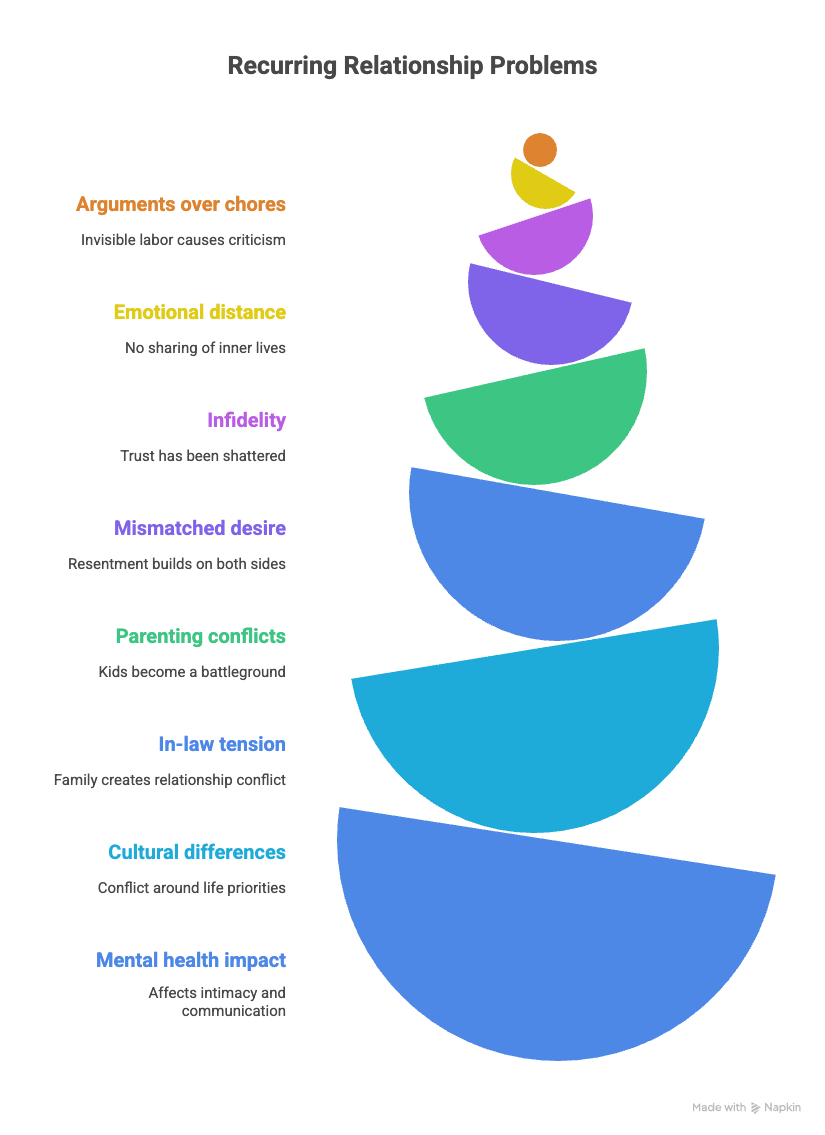
Most couples enter marriage therapy not because of a single dramatic event, but because of a cluster of recurring relationship problems that have piled up over months or years. The specifics vary, but patterns tend to repeat.
Frequent arguments over chores and finances. One partner feels like they carry the invisible labor of managing the household; the other feels constantly criticized no matter what they contribute.
Emotional distance and disconnection. You're living like roommates, handling logistics but no longer sharing your inner lives. The emotional connection that drew you together has faded.
Infidelity—emotional or physical. Trust has been shattered, and you're trying to decide whether repair is possible. This includes emotional affairs, sexting, or physical betrayal.
Mismatched desire for sex. One partner wants more intimacy; the other feels pressured or has lost interest. Resentment builds on both sides.
Parenting and step-parenting conflicts. You disagree on discipline, screen time, or how to blend families after remarriage. The kids become a battleground for unresolved relationship struggles.
In-law and extended family tension. Boundaries with parents or siblings create ongoing friction. One partner feels unsupported when their family creates relationship conflict.
Cultural or religious differences. Values you didn't fully explore before marriage now create conflict around holidays, child-rearing, or life priorities.
Impact of mental health on the relationship. Depression, anxiety disorders, mood disorders, or substance use in one partner affects intimacy, communication, and daily functioning for both. Couples therapy can improve individual mental health alongside relationship functioning.
Couples also come for positive, forward-looking reasons: premarital counseling before a 2025 or 2026 wedding, planning how to handle life transitions like having a baby, or adjusting to retirement and spending more time together. Therapy is tailored to your situation—a couple recovering from an affair will have a very different treatment plan than a couple seeking guidance before their wedding date.
Evidence-Based Approaches Used in Person
Most experienced therapists blend several research-backed methods rather than using a single rigid approach. Multiple therapeutic approaches have strong evidence for treating relationship distress.
Gottman Method Couples Therapy
Developed by Drs. John and Julie Gottman, Gottman Method Couples Therapy focuses on building the "Sound Relationship House." The approach helps couples reduce criticism, contempt, defensiveness, and stonewalling—the "Four Horsemen" that predict divorce—and replace them with fondness, admiration, and conflict resolution skills. Therapists assign structured exercises like weekly meetings and daily connection rituals to create shared meaning.
Emotionally Focused Therapy
Emotionally Focused Therapy (EFT) is attachment-based, examining the underlying fears and needs driving surface-level conflicts. Instead of focusing on who's right about the dishes, EFT explores deeper messages: "I feel like you don't care about me" or "I'm afraid I'm not enough for you." Research shows EFT and behavioral approaches both produce meaningful improvements in relationship satisfaction, with many couples seeing change in 8 to 20 sessions.
Cognitive-Behavioral and Emotion Regulation Tools
Some therapists incorporate cognitive-behavioral couple therapy techniques to help partners notice unhelpful thought patterns and replace them with more constructive ones. For couples experiencing intense emotions, therapists may use emotion regulation techniques that prevent conversations from derailing and support overall emotional health.
We understand that the best couples therapists adapt to what each relationship needs. Some couples thrive with Gottman's structured exercises. Others need EFT's emotional depth first. We often start with what feels most urgent and layer in other approaches as trust builds.
The choice of method depends on your goals, the severity of relationship distress, any past trauma history, and your preferences. Some couples prefer structured exercises and homework; others want more open emotional processing. A good therapist will discuss therapy options with you and adjust based on what's actually helping.
What to Expect in Your First In Person Couples Therapy Sessions
Most couples begin with an assessment phase spanning two to four visits. This helps everyone get oriented.
Session 1: The Initial Meeting
Your first session usually runs 75 to 90 minutes with both partners present. You'll cover your history as a couple, major relationship challenges bringing you to therapy, what you hope will change, and complete paperwork on consent, privacy, and confidentiality limits.
Many therapists use questionnaires about relationship satisfaction to establish a baseline for tracking progress and measuring meaningful change.
Individual Sessions
Many couples counselors schedule one individual session with each partner (about 45 to 50 minutes) after the joint intake. These explore your family background and how your family of origin handled conflict and emotions, past experiences or past trauma affecting your current relationship, and any safety concerns.
These individual meetings stay confidential to the extent possible, though therapists typically explain their policy on secrets (like ongoing affairs) upfront.
The Feedback Session
After gathering information, your therapist summarizes observed patterns—pursuer-withdrawer cycles, criticism-shutdown dynamics, or gridlocked conflicts—and offers a concrete treatment plan with two to three specific goals for the next 8 to 16 sessions.
Logistics include weekly or bi-weekly scheduling (weekly is more common initially), session length options (50 or 80 minutes), and cancellation policies.
It's normal to feel nervous. Consider writing down two to three key concerns and hopes for what therapy might accomplish.
Inside a Typical In Person Couples Session
Once you move past the assessment phase, therapy sessions fall into a general rhythm:
Brief check-in (5-10 minutes): What happened this week? Any homework from last session? Any urgent relationship issues?
Focused work (30-50 minutes): You'll tackle one or two key issues—either something that came up during the week or a planned topic from your treatment goals.
Exercise or guided conversation (10-20 minutes): This might be practicing a structured dialogue, role-playing a difficult conversation about finances, or using a worksheet to map out your recurring argument cycle together.
Closing and homework (5-10 minutes): The therapist summarizes what happened and assigns take-home tasks to practice before the next therapy session.
In person sessions allow the therapist to manage conflict in the room in real time: pausing heated arguments, asking partners to slow down, tracking body language that signals flooding or shutdown, and helping each partner speak and listen without interruption in a safe and supportive environment.
Your therapist can also hand you physical materials—diagrams of your conflict pattern, printed homework sheets, worksheets for tracking progress. Many couples find having something tangible to take home reinforces the work and supports lasting wellness.
Difficult topics—sex, betrayal, resentment, fears about separation—get discussed at a pace that feels safe and manageable for both partners. You won't be pressured to disclose everything in week one.
Think of sessions as practice labs, not performances. Mistakes, strong emotions, and awkward silences are expected and workable. That's what this affirming space is for.
In Person vs Online Couples Therapy: Which Is Better for You?
Both in person and online couples therapy services can be effective, and many couples use a mix over time depending on circumstances. Research shows both formats can improve relationships, though each has distinct advantages. The right choice depends on your situation, preferences, and what you're working on.
Nonverbal communication: In person therapy allows therapists to see full body language, while online sessions limit observation to upper body and face.
Distractions: In person provides a controlled, neutral environment with minimal distractions. At home, interruptions and divided attention are more common.
Privacy feeling: Many couples feel the therapy office creates a safer container for difficult conversations than their own home, especially in smaller living spaces.
Commute: In person requires travel time to the office. Online eliminates commute entirely.
Scheduling flexibility: Online often offers more evening availability, while in person depends on office hours.
Tech requirements: In person needs none. Online requires stable internet, camera, and private space.
When In Person Is Often Preferred
High-conflict couples who escalate quickly and need a therapist's physical presence to de-escalate benefit from in person work. Partners rebuilding trust after recent infidelity often find the safety and containment of a neutral space supports difficult conversations. Couples working through past trauma where feeling physically anchored and safe is important typically prefer face-to-face sessions. Situations where one partner might feel unsafe expressing themselves at home due to power imbalances also call for in person therapy.
When Online May Be More Realistic

Military deployments or frequent work travel keeping partners in different locations make online practical. Rural areas without nearby marriage counselors or family therapists often require virtual options. Mobility or health issues making travel difficult can be addressed with telehealth. Childcare logistics that make leaving home together impossible sometimes necessitate online sessions.
We find that the format matters less than consistency. Some couples start online for convenience, then realize they need the containment of our Providence office for harder conversations. Others begin in person and discover that occasional online sessions help them maintain momentum during stressful work periods. What matters most is that both partners feel they can be honest and that the work continues week to week. We're flexible about mixing formats when it serves the relationship.
If feasible, consider trying in person first and discussing with your therapist whether occasional online sessions are appropriate for maintaining continuity during travel or illness. The goal is consistent engagement, whatever form works best.
Finding an In Person Couples Therapist Near You
Finding the right therapist matters more than most couples realize. Experience with couples work specifically—not just general individual therapy experience—makes a significant difference in outcomes.
Practical Search Steps
Use professional directories. Psychology Today, Withtherapy.com and the Rhode Island Department of Health licensing board let you filter by specialty, location, and approach.
Search strategically. Try "in person couples therapy Providence" or "marriage counselors Cranston." Add filter terms like "Gottman," "EFT," or "infidelity recovery" if those apply to your relationship struggles.
Verify credentials. Check licenses through the Rhode Island Department of Health. Look for specific couples-focused training: Gottman Level 1-3 certification, ICEEFT-certified EFT therapist, or similar credentials showing clinical experience beyond a graduate degree.
Schedule consultations. Most experienced therapists offer brief phone or video consults (often free or low-cost). Talk to two or three before committing to future sessions.
During consultations with potential couples counselors, ask about their approach and typical therapy options, experience with your specific issue, session length options (50 vs. 75-80 minutes), and fees and insurance accepted.
Should Couples Therapy Be In Person?
There's no single right answer, but in person often provides advantages for high-conflict dynamics, trust rebuilding after betrayal, complex trauma work, and situations requiring strong therapeutic presence. That said, many couples achieve excellent outcomes with online therapy when logistics make in person difficult. The most important factor is finding a licensed professional you both trust.
How Much Is Couples Therapy In Person?
In person couples therapy sessions in the Providence area generally range from $150 to $300+ per session depending on location, therapist clinical experience, and session length. Some licensed marriage and family therapists offer sliding scale fees based on income.
Is Couples Therapy Typically Covered by Insurance?
Insurance coverage for couples counseling varies significantly. Some plans cover family therapy or relationship counseling when coded appropriately, while others don't cover couples work at all. Many therapists operate as out-of-network providers, meaning you can submit claims for potential reimbursement but pay upfront. HSA and FSA cards can typically be used for couples therapy services. Always check your specific benefits before starting treatment.
Trust your sense of safety and connection in the first one to three sessions. If something feels off—the therapist seems to take sides, you don't feel heard, or the approach isn't clicking—it's completely acceptable to switch. Finding the right fit is worth the effort.
Safety, Confidentiality, and When Couples Therapy May Not Be Appropriate
Confidentiality in couples therapy works similarly to individual counseling, with standard legal limits: therapists must report imminent risk of harm to self or others, child abuse, and elder abuse. Beyond these requirements, what you share stays private.
The "Secrets" Question
Licensed therapists handle individual disclosures (like an ongoing affair revealed in a private session) differently. Some have a "no secrets" policy—they won't keep information that would undermine the therapy. Others allow more discretion. Ask about this in your first meeting so you understand the ground rules.
When Standard Couples Therapy May Not Be Appropriate
In person couples therapy isn't safe or effective in all situations:
Ongoing physical violence or coercive control: If one partner fears the other's reaction to what's said in session, couples therapy can actually increase danger.
Active substance use: If one partner is actively using substances that impair their participation, individual treatment for addiction typically needs to come first, possibly through group therapy or specialized programs.
Severe safety concerns: If leaving a session together puts one partner at risk, the therapist may recommend separation of services.
In these situations, a family therapist may recommend individual counseling, safety planning, domestic violence resources, or specialized addiction treatment before or instead of couples work. This isn't rejection—it's responsible care and seeking professional guidance for your specific situation.
Asking about safety doesn't mean the therapist will pressure separation. The goal is informed, safe decision-making for both partners in a supportive environment.
Therapists also protect privacy in the physical space: closed doors, white noise machines, and careful scheduling to limit overlap in waiting rooms. This trauma informed approach extends to all the practical details.
Getting Started with In Person Couples Therapy
In person couples therapy offers something screens can't fully replicate: real-time connection in a dedicated, neutral space designed for your relationship. The ability to sit together, be fully present, and work with a trained therapist who can see and respond to both of you creates conditions for deeper emotional health and meaningful change in creating healthier relationships.
Here are your next steps:
Talk with your partner about one or two key goals for therapy. What would be different if things improved? Would you feel a deeper sense of connection? Better able to resolve conflicts? More personal growth individually and as a couple?
Make a shortlist of three in person couples therapists in Providence, Cranston, Cumberland, or Edgewood using the search strategies above. Look for licensed professionals with specific couples training.
Book an initial consultation within the next seven days. Momentum matters when couples navigate the decision to seek help.
Commit together to trying at least four to six sessions before judging whether it's helping. Real change takes time, and many therapists see improvements emerge after several sessions as trust builds.
Don't wait for a crisis. Starting now—in 2025—can prevent negative patterns from hardening over the next few years. Couples who seek help early consistently achieve better outcomes than those who wait until relationship distress becomes severe.
Take the first small step today: send an email, make a call, or fill out a contact form for an in person appointment at a Providence-area practice. It might feel uncomfortable, but that discomfort is the beginning of something better—a more fulfilling relationship with better communication and stronger emotional connection.
If you're looking for support with communication problems, conflict resolution, rebuilding trust, or any other relationship issues, the therapists at Providence Therapy Group are here to help. We offer evidence-based marriage counseling and couples therapy in a safe and supportive environment. Schedule an appointment to get started.
Disclaimer: This article is for educational purposes only and is not a substitute for professional medical advice, diagnosis, or treatment. Always seek the advice of your physician or qualified mental health provider with any questions you may have regarding a medical or mental health condition. If you are in crisis or experiencing thoughts of self-harm, please call 988 (Suicide and Crisis Lifeline) or go to your nearest emergency room.