
Relationship OCD: What It Is, Symptoms, and Evidence-Based Treatment
Relationship OCD: What It Is, How It Shows Up, and What Actually Helps
Do you constantly question whether you truly love your partner, even though the relationship seems good? Do you spend hours analyzing your feelings, comparing your relationship to others, or seeking reassurance that you’re with the “right person”? Do intrusive doubts about your romantic relationship consume so much time and energy that they interfere with your daily life?

If this sounds familiar, you might be experiencing relationship OCD. Relationship OCD—commonly called ROCD—is not a separate diagnosis, but rather a specific type of obsessive-compulsive disorder where obsessions and compulsions focus on romantic relationships. Like other forms of OCD, it involves unwanted, intrusive thoughts and compulsive behaviors that cause significant distress. Negative thoughts, especially those centered on doubts, responsibilities, or catastrophic predictions about the relationship, often drive the distress and compulsive behaviors seen in ROCD.
This guide will help you understand what relationship OCD actually is, how to recognize the symptoms, how it differs from normal relationship doubts, and what evidence-based treatments can help. ROCD is increasingly recognized in clinical and research settings, leading to a growing body of literature and resources to better understand and address its effects.
What Is Relationship OCD?
Relationship obsessive-compulsive disorder (OCD ROCD) is a pattern of obsessive-compulsive disorder where the obsessions and compulsions center on romantic relationships. OCD affects approximately 1-3% of adults in the general population and is characterized by repetitive, unwanted thoughts that are intrusive and cause marked anxiety.
In relationship OCD, these unwanted thoughts and intrusive doubts focus specifically on doubts and fears about your romantic relationship. The key feature is that the thoughts are unwanted and distressing—they’re not reflections of how you actually feel about your partner or your relationship. Instead, they’re OCD symptoms that have latched onto your relationship as the focus of obsessive doubt. People with ROCD may become preoccupied with their partner's feelings toward them, obsessively questioning whether their partner truly loves them or is satisfied in the relationship, which can lead to further doubt and distress.
People with ROCD experience significant distress and impairment in their daily functioning. The obsessions aren’t just passing concerns—they’re persistent, relationship-related OCD symptoms that consume considerable time and cause intense anxiety. These symptoms are often driven by maladaptive, extreme, or unrealistic relationship-related beliefs; such beliefs, like overestimating the negative consequences of being in the 'wrong' relationship or being alone, can contribute to the maintenance of ROCD symptoms and increase emotional distress.
What Are the Symptoms of ROCD?
ROCD involves both obsessions and compulsions, just like other forms of OCD. Understanding these ROCD symptoms can help you recognize whether what you're experiencing is relationship OCD or common relationship doubts.
Obsessions: Intrusive, Unwanted Thoughts
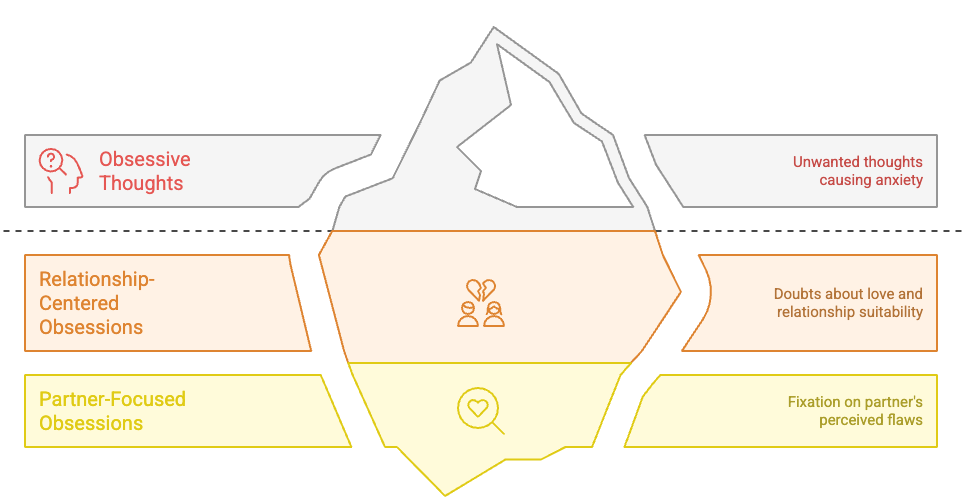
Obsessions are unwanted thoughts that intrude into your mind repeatedly and cause significant anxiety or distress. In relationship OCD, these obsessive thoughts are a form of negative thoughts that contribute to the distress and compulsive behaviors seen in ROCD. They typically fall into two categories:
Relationship-Centered Obsessions focus on the relationship itself and your own feelings:
“Do I really love my partner?”
“Is this the right relationship for me?”
“What if I’m settling or missing out on someone better?”
“Am I attracted enough to my partner?”
“How do I know this relationship is good enough?”
“What if this becomes a destructive relationship?”
Partner-Focused Obsessions focus on your partner’s perceived flaws or characteristics:
Fixating on aspects of your partner’s appearance, intelligence, or personality
Constantly noticing perceived flaws you find “imperfect”
Obsessing over your partner’s past relationships (retroactive jealousy)
Comparing your romantic partner to previous partners or other people
Worrying that such perceived flaws make the relationship unsuitable
These negative thoughts are not voluntary or pleasurable. They’re intrusive, distressing, and often go against what you consciously want to think about. Many people also develop an inflated sense of what a “perfect” relationship should look like, which fuels the obsessive doubt.
Compulsions: Repetitive Behaviors
To reduce the anxiety caused by these obsessions, people with ROCD engage in compulsive behaviors—repetitive actions or mental acts aimed at reducing distress. Common compulsions in relationship OCD include:
Reassurance seeking: Repeatedly asking your partner, friends, or family if they think you love your partner or if the relationship is right
Mental review: Constantly analyzing past interactions or memories to "prove" your feelings
Comparison: Repeatedly comparing your relationship to others' secure relationships
Testing feelings: Imagining being with someone else or checking your physical/emotional reactions to your partner
Research: Searching online for "signs of true love" or relationship advice
Avoidance: Avoiding situations that trigger relationship doubts, like seeing other couples
Many people feel compelled to perform these behaviors even though they know rationally they won't provide lasting relief. These compulsions provide only temporary relief. While they might reduce anxiety in the moment, they ultimately maintain the OCD cycle and make the obsessions stronger over time.
In our work with Providence-area clients experiencing relationship OCD, we've noticed that many people initially believe their constant doubts mean they're in the wrong relationship. What we help them understand is that ROCD is fundamentally about intolerance of uncertainty, not about relationship quality. The obsessive doubt is the symptom—not evidence that something is wrong with the relationship. Most clients with ROCD are actually in loving, secure relationships with partners they genuinely care about.
What Does OCD Look Like in Relationships?

Living with relationship OCD can make even loving and secure relationships feel uncertain or unsafe. Here’s how ROCD symptoms typically show up in daily life:
Constant Mental Preoccupation: You might spend hours each day consumed by relationship doubts, analyzing your feelings, or worrying about the relationship. This mental preoccupation interferes with work, social activities, and other aspects of life.
Emotional Numbness or Disconnection: Many people with ROCD feel emotionally numb or disconnected in their romantic relationships. You might worry that you don’t feel “enough” love or that you’re not experiencing the “right” emotions—which then becomes another source of obsessive doubt.
Intense Anxiety and Distress: The intrusive doubts trigger severe personal distress and intense anxiety. You might feel panicked, guilty, or deeply uncomfortable with the uncertainty about your own feelings.
Impact on Both Partners: ROCD affects not just the person experiencing it, but their romantic partner too. A key source of distress is the obsessive preoccupation with your partner's feelings—constantly questioning whether your partner truly loves you or analyzing their emotions toward you. This ongoing focus on your partner's feelings and perceived relationship flaws can be exhausting for both people. Partners may feel hurt, confused, or inadequate when you repeatedly seek reassurance or doubt their love, which can strain emotional stability, sexual satisfaction, and overall relationship quality.
Feel Compelled to Analyze Everything: You might feel compelled to constantly analyze or “test” your feelings and your partner’s behavior to gain certainty. This might include checking how you feel during specific activities or analyzing whether you’re “happy enough.”
Guilt and Shame: Many people with ROCD feel guilty that their OCD-related doubts might ruin their relationship, or ashamed about the intrusive thoughts they’re having about their partner. Low self-esteem often develops from constantly doubting your own feelings and judgment.
How Is ROCD Different from Normal Relationship Doubts?
Everyone experiences some relationship doubts—this is completely normal. So how do you tell the difference between common relationship doubts and relationship OCD?
Normal Relationship Doubts
Normal relationship doubts:
Come and go, rather than being constant
Don't consume hours of your day
Can usually be worked through by discussing concerns with your partner or reflecting on the relationship
Don't cause severe distress or impairment in daily functioning
Involve questioning specific aspects of compatibility or circumstances
Respond to reassurance and rational thinking
Relationship OCD Symptoms
ROCD symptoms, by contrast:
Are persistent, intrusive, and feel uncontrollable
Consume significant time (more than an hour per day)
Feel stuck—you can't "work through" them no matter how much you analyze
Cause significant distress and impairment in daily life, work, or social situations
Focus on existential uncertainty ("Do I love them?" rather than "Are we compatible?")
Don't respond to reassurance—you might feel better briefly, but the doubts return
Lead to compulsive behaviors aimed at reducing anxiety
Are distressing precisely because they conflict with what you want to feel
The key difference is that ROCD involves obsessive thoughts that are intrusive, time-consuming, and lead to compulsive behaviors. The intrusive doubts in ROCD are also characterized by intense discomfort with uncertainty that drives repetitive attempts to gain absolute certainty.
From a clinical perspective, we approach ROCD as an OCD-related condition rather than a relationship problem. The diagnostic and statistical manual classifies it under obsessive-compulsive disorder because the core issue is OCD symptoms that happen to focus on relationships. This is an important distinction because it means the solution isn't necessarily couples therapy or relationship work—it's OCD treatment. Once the OCD is addressed, many people find their relationship satisfaction actually improves.
How Is Relationship OCD Diagnosed?
There's no separate diagnosis for "relationship OCD" in the statistical manual of mental disorders classification systems. Instead, ROCD is diagnosed as OCD with relationship-focused symptoms.
A mental health professional will assess whether your symptoms meet the criteria for OCD:
Presence of obsessions and/or compulsions
The obsessions or compulsions are time-consuming (taking more than one hour per day) or cause significant distress or impairment in your daily life
The symptoms are not better explained by another mental health condition
Your provider may use validated screening tools like the Yale-Brown Obsessive-Compulsive Scale to help diagnose OCD and determine symptom severity.
It's important to note: Both men and women can experience ROCD, and it can occur at any stage of an existing relationship. ROCD symptoms are not limited to romantic relationships—some research indicates they can also affect friendships, familial relationships, and other intimate relationships, though romantic relationships are most commonly affected. People with ROCD may also experience other OCD symptoms beyond relationship-focused obsessions.
Seeking Reassurance in Relationships
Reassurance seeking is hands down one of the most challenging compulsions that crops up in relationship obsessive compulsive disorder (ROCD). When you're caught in the grip of obsessive compulsive disorder that's hijacked your romantic relationship, you'll find yourself repeatedly hunting for confirmation from your partner about their love, commitment, or attraction. Picture this: you're asking "Do you really love me?" or "Are you sure you want to be with me?"—sometimes multiple times a day, like a broken record. You might also turn to friends, family, or even social media for that validation hit, desperately hoping to quiet the relentless mental chatter and anxiety swirling around in your head.
Here's what's really happening: while seeking reassurance might give you a brief taste of relief, it quickly becomes part of the OCD tug-of-war. The more you ask, the more your mind cranks up its demands for certainty, and the less confident you actually feel in your relationship. Over time, this pattern can stir up serious tension and frustration for both you and your partner. Your partner may feel overwhelmed, confused, or even resentful—especially when they sense that nothing they say ever feels like "enough" to calm the storm in your mind. In some cases, reassurance seeking can spiral into more destructive territory, like testing your partner's loyalty or accusing them of things you don't truly believe.
Take a step back and remember this: reassurance seeking is a symptom of relationship obsessive compulsive disorder—not a reflection of your relationship's quality or your partner's actions. These compulsive behaviors get fueled by underlying maladaptive beliefs and obsessive compulsive symptoms, not by actual problems brewing in the relationship. Recognizing this can be your first step toward breaking free from the cycle. With the right support and treatment, you can learn to manage that urge to seek reassurance, address what's really driving your anxiety underneath, and build a more secure, trusting connection with your partner—one that doesn't depend on constant confirmation.
OCD Related Beliefs and Relationship Satisfaction
The beliefs you hold about relationships can have a powerful impact on your experience of relationship obsessive compulsive disorder (ROCD)—and your overall relationship satisfaction. Many people with obsessive compulsive disorder struggle with rigid, perfectionistic, or unrealistic expectations—such as believing that true love should always feel certain, or that any doubt means you're in the wrong relationship (spoiler alert: that's not how healthy relationships actually work). These OCD-related beliefs can fuel intrusive thoughts and compulsive behaviors—like excessive reassurance seeking or constant questioning—that undermine both your own sense of security and your partner's trust.
When intrusive thoughts and doubts take center stage, it can feel like you're walking a tightrope—struggling to feel emotionally connected or satisfied in your relationship. You may find yourself caught in a cycle of analyzing your feelings, criticizing your partner, or feeling compelled to "test" the relationship in search of certainty. What's really happening? Your OCD is hijacking your relationship experience, creating a sense of unpredictability and tension that makes it hard for both you and your partner to relax and enjoy your time together. Research shows that individuals with ROCD often report lower relationship satisfaction and more frequent conflict compared to those without obsessive compulsive symptoms—but here's the thing: it doesn't have to stay that way.
The good news is that these patterns can change—and you don't have to let OCD steer the ship forever. Cognitive behavioral therapy (CBT) and exposure and response prevention (ERP) are highly effective treatments for relationship OCD. By working with a therapist trained in these approaches, you can learn to identify and challenge maladaptive beliefs, tolerate uncertainty (yes, even in relationships!), and respond to intrusive thoughts in healthier ways. Over time, this can lead to greater emotional stability, improved communication, and a deeper sense of fulfillment in your relationship. Remember, ROCD is a treatable condition—and with the right support, you and your partner can build a more secure and satisfying connection.
How Do You Treat Relationship OCD?
The good news is that effective, evidence-based treatment options exist for relationship OCD. The same treatments that work for other OCD symptom dimensions are effective for relationship-focused obsessions and compulsions.
Exposure and Response Prevention (ERP): First-Line Treatment
Exposure and response prevention is the most effective treatment for obsessive-compulsive disorder and should be the first-line therapy when available. ERP is a specialized form of cognitive-behavioral therapy that directly targets the OCD cycle.
How ERP works for ROCD:
Exposure: You gradually and systematically confront situations or thoughts that trigger your relationship obsessions. For example:
Spending time with your partner without seeking reassurance
Deliberately thinking about relationship doubts without trying to push them away
Exposing yourself to situations that typically trigger comparison or analysis
Response Prevention: You practice refraining from performing compulsions. This means:
Not asking for reassurance from your partner, friends, or family
Not mentally reviewing your feelings or past interactions
Not comparing your relationship to others
Not checking your emotional or physical reactions to your partner
Through repeated practice, you learn that the anxiety decreases on its own without performing compulsions, and that the feared outcomes (like discovering you don't love your partner) are unlikely to occur or that you can cope effectively if they do.
What to Expect from Treatment
Effective ROCD treatment typically involves:
Weekly or twice-weekly cognitive behavioral therapy sessions lasting 60-90 minutes
At least 12 weeks of treatment
Daily homework assignments to practice exposure exercises
60-85% of people experience significant reduction in OCD symptoms with ERP
Benefits can be maintained for up to 5 years after treatment ends
Important considerations:
Therapy should be provided by clinical psychologists or therapists trained in cognitive-behavioral therapy for OCD, particularly response prevention therapy
Traditional talk therapy alone is typically not effective for obsessive-compulsive disorder
The goal is to help you make decisions based on your actual relationship experiences rather than OCD-related fears and maladaptive beliefs
Additional Treatment Components
Practicing self-compassion is vital in treating ROCD. Many individuals blame themselves for their intrusive doubts, but these thoughts are OCD symptoms, not reflections of your true feelings.
Mindfulness and grounding techniques can help when facing intrusive thoughts associated with ROCD. These strategies help you observe thoughts without getting caught up in them.
Medication: SSRIs may be beneficial alongside therapy for managing ROCD symptoms, especially if you have co-occurring anxiety or related disorders.
We've worked with many clients in Providence, Cranston, Cumberland, and throughout Rhode Island who felt overwhelmed by relationship doubts and worried their OCD had ruined their relationship. What we consistently observe is that when ROCD is properly treated with exposure and response prevention therapy, people often realize the relationship was never the problem—the OCD was. The relief people experience when they can finally enjoy their relationship without constant doubt is profound.
Getting Help in Providence
If you're experiencing symptoms of relationship OCD, several resources are available in the Providence area:
RICBT Rhode Island offers specialized CBT and ERP for OCD
Butler Hospital provides comprehensive OCD treatment programs
Providence Therapy Group offers evidence-based therapy for OCD-related conditions
You should seek help from a mental health professional if:
Relationship doubts consume more than an hour per day
You engage in compulsive behaviors you can't stop despite wanting to
Your symptoms cause significant distress or interfere with daily life
Your partner is feeling hurt or exhausted by constant seeking reassurance
You feel stuck in repetitive thoughts and behaviors related to your relationship
Connecting with others who understand ROCD through OCD groups (available through the International OCD Foundation) can also reduce feelings of isolation for those affected.
Moving Forward
Relationship OCD can make loving and secure relationships feel uncertain and exhausting. The constant intrusive doubts can consume your time, energy, and peace of mind. But here's what's important to remember: ROCD is a treatable form of OCD, not a sign that you're in the wrong relationship.
With proper treatment—particularly exposure and response prevention therapy—most people experience significant improvement in their OCD symptoms and can enjoy their intimate relationships without constant obsessive doubt. You can learn to tolerate uncertainty, reduce compulsive behaviors, and experience the connection you desire.
If you're struggling with relationship OCD, the therapists at Providence Therapy Group are here to help. We provide evidence-based cognitive-behavioral therapy for OCD, including specialized treatment for relationship-centered obsessions and partner-focused symptoms. Schedule an appointment to get started.
Frequently Asked Questions About Relationship OCD
What are common obsessive compulsive symptoms in relationship OCD?
People with relationship OCD often experience intrusive doubts and obsessive thoughts about their romantic relationship or partner. These obsessive compulsive symptoms include repetitive behaviors like reassurance seeking, constant comparison, mental review, and testing their own feelings to gain certainty. Such compulsions provide only temporary relief but maintain the cycle of obsessive doubt.
How can I distinguish relationship OCD from normal relationship doubts?
While normal relationship doubts are occasional and manageable, relationship OCD involves persistent, intrusive thoughts that cause significant distress and interfere with daily life. ROCD symptoms feel uncontrollable and lead to compulsive behaviors like seeking reassurance from friends, family, or the partner. Unlike common relationship doubts, ROCD is characterized by intense anxiety and an inflated sense of responsibility about making the "right relationship" decisions.
What role do maladaptive beliefs play in relationship OCD?
Maladaptive beliefs, such as overestimating the negative consequences of being in the wrong relationship or being alone, contribute to the severity of ROCD symptoms. These beliefs fuel obsessive doubt and compulsive behaviors by increasing anxiety about the relationship's future, often leading to partner scares and relationship-centered obsessions.
Why does relationship OCD require research attention?
Relationship OCD is a commonly referred subtype of obsessive compulsive disorder that causes severe personal and relational distress. Despite its significant impact, it has only recently gained research attention. Understanding ROCD better helps improve treatment options and awareness, benefiting both individuals affected and their partners.
Can relationship OCD affect friendships and family relationships?
Yes, although ROCD most commonly affects romantic relationships, similar obsessive compulsive symptoms and maladaptive beliefs can also occur in other intimate relationships, including those with friends and family. These relationship-related OCD symptoms can cause significant distress and impair daily functioning across various relationship contexts.
Disclaimer: This article is for educational purposes only and is not a substitute for professional medical advice, diagnosis, or treatment. If you are seeking more information about panic attacks and how to manage them, please refer to reputable resources. Always seek the advice of your physician or qualified mental health provider with any questions you may have regarding a mental health condition. If you are in crisis or experiencing thoughts of self-harm, please call 988 (Suicide and Crisis Lifeline) or go to your nearest emergency room.