
Working on Your Relationship Solo: What Individual Therapy for Relationship Issues Can (and Can't) Do
You're struggling in your relationship. Maybe communication has broken down, conflicts feel unsolvable, or you're repeating the same painful patterns. You know something needs to change, but there's a problem: your partner isn't willing to go to couples therapy, or maybe you're not in a relationship right now but want to address patterns that keep showing up.

So you're considering individual therapy for your relationship issues. But will it actually help? Can working on your relationship alone create meaningful change when relationships, by definition, involve two people?
The answer is nuanced. Individual therapy for relationship issues can be valuable—helping you understand your patterns, improve communication skills, and work on personal growth that benefits your relationships. But it also has real limitations compared to couples therapy, and understanding both what it can and can't do is essential for setting realistic expectations.
This guide explains when individual therapy for relationship issues makes sense, what you can realistically achieve, what the limitations are, and how to make the most of this approach.
Is Couples Therapy Always Better Than Individual Therapy for Relationship Issues?
Let's start with the research: conjoint couple therapy remains the gold standard for treating relationship distress. When both partners can participate, couples therapy is the most effective approach for addressing relationship issues.
A meta-analysis of 58 studies representing 2,092 couples found couple therapy has a large effect on relationship satisfaction, with gains in communication, emotional intimacy, and partner behaviors maintained over short- and long-term follow-up. The effect size was substantial—couples in therapy improved dramatically while couples on waitlists showed no significant improvement.
Research from 2010-2019 identifies Behavioral Couple Therapy, Cognitive Behavioral Couple Therapy, Emotionally Focused Therapy, and Integrative Behavioral Couple Therapy as "well-established" evidence-based treatments for couple relationship distress. Notably, no individual therapy approaches met criteria as evidence-based treatments for relationship distress in this comprehensive review.
So why consider individual therapy at all? Because in the real world, couples therapy isn't always possible. Individual therapy for couple problems often occurs when one partner refuses conjoint therapy or due to therapist or client format preferences. Despite couples therapy being more effective, many people seeking help for relationship problems ultimately receive individual therapy.
The question isn't whether individual therapy is better—it's whether it can still help when couples therapy isn't an option. Individual relationship counseling focuses on personal growth and self-awareness as pathways to healthier relationships.
What Can Individual Therapy Actually Achieve for Your Relationship?
Individual therapy for relationship issues won't fix your relationship the way couples therapy can, but it can create meaningful personal growth that improves how you show up in relationships.
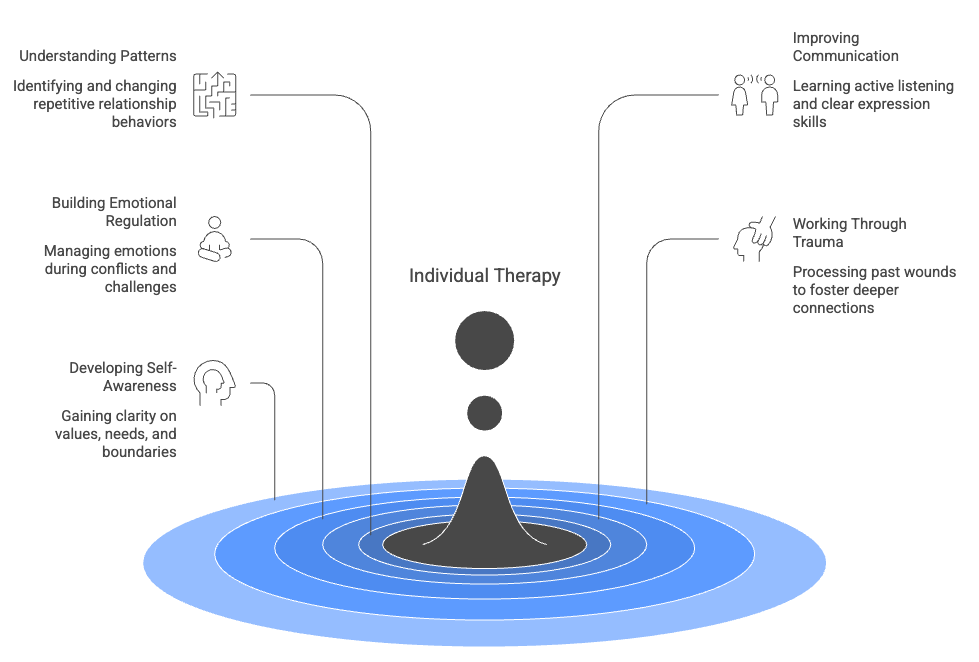
Understanding Your Relationship Patterns
Individual therapy helps you identify relationship patterns that repeat across relationships. Maybe you withdraw during conflict, pursue reassurance anxiously, or recreate dynamics from your family of origin. A mental health professional can help you see these patterns clearly and understand where they come from.
This self-awareness is valuable. When you recognize that you're reacting from past emotional wounds rather than responding to present circumstances, you can start making different choices. You can't control your partner's behavior, but you can change your own behavioral patterns.
Relationship difficulties often stem from unresolved personal issues that individual therapy can address. The therapeutic process involves exploring how past relationships and experiences shape current relationship dynamics.
Improving Your Communication Skills
You can learn and practice communication skills in individual therapy—active listening, expressing needs clearly, managing emotions during difficult conversations, and resolving conflicts constructively. Your therapist can role-play scenarios, help you prepare for conversations, and teach you conflict resolution strategies.
The limitation: Learning communication skills individually is different from practicing them with your partner in real-time with a therapist guiding the interaction. You're working with your best guess about what your partner thinks and feels rather than their actual experience. But developing these skills can still help you improve communication and reduce communication breakdowns outside therapy.
Individual relationship counseling can address your communication style and teach you how to navigate relationship challenges more effectively, even when your partner isn't participating in the therapeutic process.
Building Emotional Regulation
Individual therapy can help you manage your emotional responses in relationships. If you tend to become flooded during conflicts, shut down emotionally, or react intensely to perceived rejection, therapy can teach you emotional regulation techniques and coping strategies.
When you can stay calmer and more present during relationship challenges, you create more space for productive conversations. This personal growth genuinely benefits your relationships, even though it doesn't directly address your partner's patterns or the relationship dynamics between you. Better emotional balance contributes to healthier relationship dynamics.
Working Through Past Trauma and Emotional Wounds
Unresolved trauma—from childhood, past relationships, or other experiences—often affects current relationship dynamics. Individual therapy provides a safe and supportive environment to process these emotional wounds without involving your partner in that healing work. Addressing underlying emotions from past experiences can improve your emotional health and capacity for deeper emotional connections.
This can be particularly valuable when your relationship issues stem partly from personal history rather than current relationship problems. Addressing your own trauma can reduce its impact on your relationship, even if your partner isn't in the therapy room.
Developing Self-Awareness and Personal Empowerment
Individual therapy supports self-discovery and personal growth. You might gain clarity about your values, needs, and boundaries in relationships. You might build self-esteem that was undermined in past relationships or address negative thought patterns that affect how you relate to others. This personal empowerment can help you make healthier choicesand build more fulfilling relationships.
Therapy for relationship issues in an individual format helps you develop a comprehensive understanding of your patterns, even though it can't directly change relationship dynamics between you and your partner.
In our work with clients at the Providence Therapy Group, we've found that individual therapy for relationship issues works best when people come in with realistic expectations. We often tell clients: "You can change yourself, and that genuinely matters. You can develop better communication skills, understand your patterns, and work through past wounds. But you can't change your partner from this room." When people focus on their own growth rather than trying to fix their partner through individual therapy, they make meaningful progress that often does benefit their relationships.
What Are the Real Limitations of Individual Therapy for Relationship Issues?
Understanding what individual therapy can't do is just as important as understanding what it can do. Research identifies five major concerns with individual therapy for couple problems:
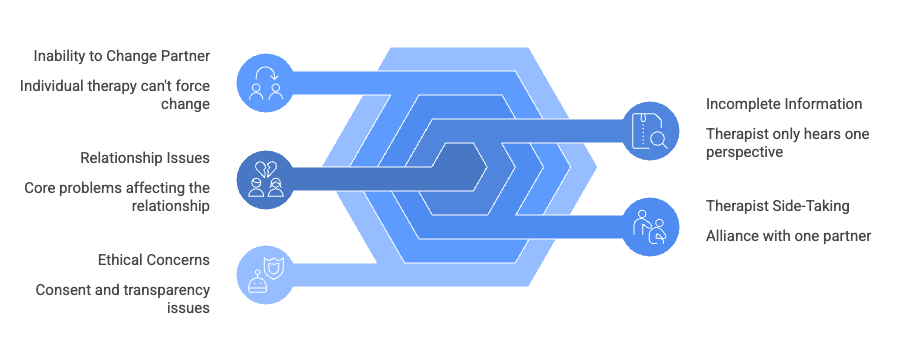
You're Working with Incomplete Information
When you describe relationship issues to your therapist, they're hearing only your perspective. Your therapist doesn't have access to your partner's experience, motivations, or side of the story. This creates inaccurate assessments based on single-partner reports, which can lead to therapy focused on the wrong issues.
Your perception of what's happening in your relationship is real and valid, but it's not the complete picture. Couples therapy allows both partners to share their experiences, helping the therapist understand the full relationship dynamics and work toward mutual understanding.
Your Therapist May Unintentionally Take Sides
Therapist side-taking and alliance issues are significant concerns in individual therapy for couple problems. Your therapist naturally develops an alliance with you—the person in the room. It's hard for them to maintain neutrality about your partner when they only hear about them through your descriptions.
This can inadvertently reinforce your perspective rather than helping you see alternative viewpoints or understand your role in relationship dynamics. In couples therapy or couples counseling, the therapist maintains alliance with both partners and the relationship itself.
It Can't Change Your Partner
This seems obvious, but it's worth stating clearly: individual therapy can't change your partner's behavior, communication patterns, or emotional responses. You can change yourself, and that might inspire changes in your partner—but it also might not.
Research found that those attending individual-oriented relationship programs reported significant decreases in individual distress but no significant relationship gains. Your personal distress might improve while the relationship itself remains troubled. Relationship satisfaction often requires both partners working together, not just one person changing.
There Are Structural Constraints on Change
Individual therapy faces structural constraints on creating relationship change. Relationship problems exist in the interaction between partners—the way you communicate together, respond to each other, and navigate relationship challenges as a team. Individual therapy can't directly address these interactive patterns because both people aren't present.
It's like trying to improve a dance by coaching only one partner. You can help that person develop better technique, but the dance itself requires both partners working together in real-time. Poor communication and relationship conflictsoften require both partners' participation to fully resolve.
There Are Ethical Concerns for Both Partners
Ethical issues affect both the attending and non-attending partner in individual therapy for couple problems. The non-attending partner isn't giving consent to be discussed in therapy, yet they're often a major focus. The attending partner might share their therapist's feedback or interpretations with their partner in ways that create conflict rather than resolution.
Additionally, if you're working toward leaving the relationship in individual therapy while your partner believes you're working on staying together, this creates ethical complications.
We see many people who start individual therapy hoping their partner will eventually join them in couples work, and sometimes that does happen. We've also seen people who hoped individual therapy would save their relationship ultimately gain clarity that the relationship isn't healthy for them. Both outcomes represent important growth. Individual therapy can't predict or guarantee where your relationship will end up, but it can help you understand your patterns, needs, and choices more clearly. That clarity is valuable regardless of the relationship's outcome.
When Does Individual Therapy for Relationship Issues Make Sense?
Given these limitations, when is individual therapy for relationship issues actually appropriate?
Your Partner Refuses Couples Therapy
This is the most common scenario. If your partner won't attend couples therapy but you're committed to working on yourself and the relationship, individual therapy can help. You can't force your partner into therapy, but you can address your own patterns and growth.
Sometimes, when one partner starts making changes in individual therapy, the other partner becomes more willing to seek couples therapy. Individual therapy can be a bridge to eventual couples work, though this isn't guaranteed. When seeking therapy for relationship concerns, individual work can be a starting point.
You're Not Currently in a Relationship
If you're single but recognize problematic patterns in your past relationships, individual therapy is the appropriate format. You can explore relationship patterns, attachment styles, communication challenges, and personal issues that affect your romantic relationships without needing a partner present.
This preventive work can help you build healthier relationships in the future. Addressing relationship issues through individual therapy while you're single can prepare you for more satisfying relationships when you're ready.
You Have Individual Mental Health Issues Affecting Your Relationships
If you're dealing with depression, anxiety, trauma, or other mental health challenges that impact your relationships, individual therapy makes sense. For patients with major depressive disorder and relationship distress, research found no significant difference between couples-focused therapy and individual therapy for reducing depression symptoms, though couples-focused therapy showed better recovery and symptom improvement compared to waitlist controls. Group-based options can also support anxiety, depression, and relationship challenges.
Addressing your mental health can improve your capacity for healthier relationships, even if it doesn't directly resolve relationship problems. Mental health issues can create personal challenges that affect relationship quality.
You Need to Address Personal Issues First
Sometimes personal work needs to happen before couples work is productive. If you need to process trauma, build emotional regulation skills, or develop self-awareness about your patterns, individual therapy provides that foundation.
You might later transition to couples therapy once you've done necessary individual work. Relationship therapy can take different forms depending on what you need at different stages.
Major Life Transitions Are Affecting Your Relationships
Major life transitions—job changes, relocation, grief, illness, or other significant changes—can strain relationships. Individual therapy can help you process these transitions and manage how they're affecting your relationship dynamics, even if your partner isn't ready to participate in relationship counseling, and this is especially true around perinatal mental health challenges such as pregnancy and postpartum.
Safety Concerns Make Couples Therapy Inappropriate
If there's domestic violence, abuse, or significant safety concerns in your relationship, couples therapy is contraindicated. Individual therapy can help you understand the dynamics, develop safety plans, and make decisions about the relationship.
How to Make Individual Therapy for Relationship Issues More Effective
If you're pursuing individual therapy for relationship concerns, these strategies can maximize its effectiveness:
Be Honest About the Limitations
Tell your therapist you understand you're getting therapy for relationship issues and that this has inherent limitations. Ask them to help you stay aware of when issues require couples work versus individual work.
Focus on What You Can Control
Concentrate therapy on your patterns, reactions, communication skills, and personal growth rather than trying to figure out how to change your partner. The most productive individual therapy for relationship issues focuses on your contribution to relationship dynamics.
Stay Open to Your Partner's Perspective
Ask your therapist to help you consider alternative interpretations of situations and your partner's possible motivations, even though your partner isn't there to share them directly. Try to maintain curiosity about your partner's experience rather than certainty about your interpretation. Deeper connections require mutual understanding, which is harder to achieve through individual work alone.
Consider This a Bridge, Not the Destination
If you're in a relationship, view individual therapy as potentially a step toward couples therapy rather than a replacement for it. Be open to transitioning to couples work if your partner becomes willing. Family therapy or couples counselingmay eventually become options if both partners are willing to participate.
Be Transparent with Your Partner
When appropriate and safe, let your partner know you're working on relationship issues in individual therapy. This transparency can reduce suspicion and might eventually increase their openness to couples work.
From a clinical perspective, the most effective individual therapy for relationship concerns involves honest conversations about what's realistic. We ask clients to stay curious about their partner's perspective even though their partner isn't in the room. We help them distinguish between personal patterns they can change and relationship dynamics that require both partners' participation. When clients understand these distinctions, they can make the most of individual work while staying open to couples therapy if their partner becomes willing. This balanced approach creates meaningful growth.
Getting Help at the Providence Therapy Group
If couples therapy isn't currently an option—whether because your partner is unwilling, you're not in a relationship, or you need to address personal issues first—individual therapy for relationship issues can still support your growth and improve how you navigate relationship challenges.
At the Providence Therapy Group, our therapists understand both the value and limitations of individual therapy for relationship concerns. We provide evidence-based therapy in a supportive environment where you can explore relationship patterns, develop communication skills, work through emotional wounds, and build self-awareness.
With offices in Providence and Cumberland, we serve clients throughout Rhode Island including Providence, Cranston, Edgewood, and surrounding areas. We offer both in-person sessions and online therapy, giving you flexibility in how you access mental health care.
Individual therapy for relationship issues isn't a substitute for couples therapy when both partners can participate, but it can create meaningful personal growth that benefits your relationships. Whether you're addressing patterns from past relationships, working on yourself while hoping your partner will eventually join you in couples work, or developing skills for healthier relationships, therapy can help.
If you're ready to explore how individual therapy can support your relationship concerns, schedule an appointment to speak with one of our experienced therapists or arrange an online or in-person consultation in Providence.
Disclaimer: This article is for educational purposes only and is not a substitute for professional medical advice, diagnosis, or treatment. Always seek the advice of your physician or qualified mental health provider with any questions you may have regarding a medical condition or mental health concern. If you are in crisis or experiencing thoughts of self-harm, please call 988 (Suicide and Crisis Lifeline) or go to your nearest emergency room.