
What Your Drained Social Battery Is Actually Telling You (And What to Do Next)

You made it through the party, the family dinner, the back-to-back meetings. Now you're sitting in your car in the driveway, not ready to go inside. Or you're home, but you can't explain why you feel more wiped out than after a run. A depleted social battery isn't a character flaw. It's a signal. And once you know how to read what your social battery is telling you, you can actually do something useful with it.
What Does "Social Battery" Actually Mean?
Your social battery is your energy reserve for social interaction — a real phenomenon, not a personality quirk or a sign that you dislike people. Research shows that socially demanding behavior produces immediate gains, delayed fatigue, explaining why you might feel great during a gathering and hollow afterward. The fatigue isn't in your imagination. It shows up in the data.
One useful way to think about it: social contact operates like a basic biological need. 8 hours of social isolation produces fatigue comparable to not eating for the same period — comparable to the effects of not eating for the same period. Too much isolation depletes you. But so does too much social stimulation. Your nervous system is trying to maintain a balance.
The social battery concept is a metaphor for that balance point. When you have a low social battery, your body and mind signal that your social energy limits have been reached and restoration is overdue. Social battery management starts with recognizing that signal before it turns into complete depletion. Think of each social interaction as drawing from a finite reserve.
How Do I Know If My Social Battery Is Low?
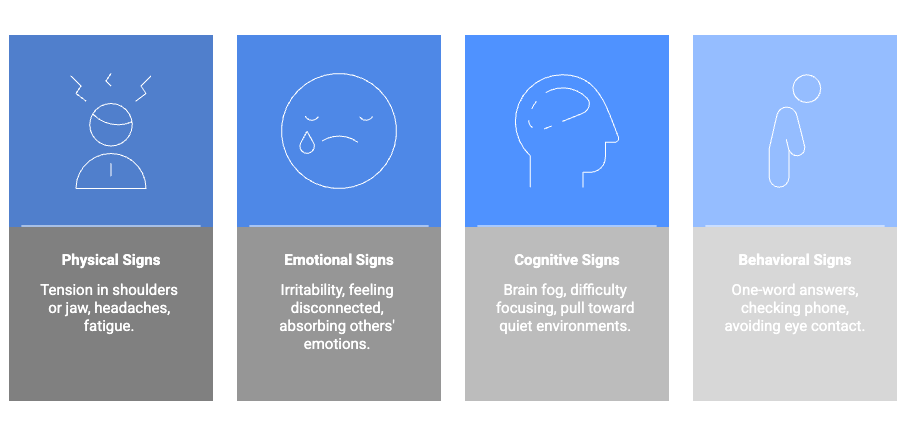
A low social battery shows up across four areas — and most people notice the behavioral signs last.
Physical signs
Tension in your shoulders or jaw
Headaches or a vague heaviness behind your eyes
Fatigue that sleep doesn't fully explain
Emotional signs
Irritability that seems disproportionate to what's happening
Feeling disconnected or flat, even around people you care about
Taking on others emotions more than usual — absorbing others emotions is a sign your nervous system is already overloaded
Cognitive signs
Brain fog and difficulty focusing
Struggling to track conversations or remember what someone just said
A strong pull toward quiet, low-stimulation environments
Behavioral signs
One-word answers when you'd normally be more engaged
Checking your phone more than usual
Actively avoiding eye contact or looking for an exit
Most people catch the behavioral signs of a low social battery only after they've hit a wall. Early signs — mild fatigue, shorter responses, less patience for small talk — are easier to miss. But each depleting social interaction makes the next one more effortful. Feeling drained after spending time in social situations is your nervous system asking for a pause, not a personal failing. The longer you push through, the faster the battery runs down.
Why Does Social Interaction Drain Your Energy?
Social interaction requires genuine cognitive and emotional work — not just pleasantries. Every conversation involves self-monitoring, reading social cues, managing your emotional expression, and responding in real time. This draws on the same self-regulatory resources you use for focus, decision-making, and willpower. Those self-regulatory resources are limited and sustained social demands deplete them.
There's also the question of emotional labor — the gap between what you feel and what the social situation requires you to express. Performing cheerfulness when you're tired, staying engaged when you'd rather be elsewhere, managing others emotions on top of your own — processing others emotions adds to your social load in ways that are easy to undercount.
Emotionally depleted people default to "faking it," which drains social energy faster than genuine engagement. That creates a cycle: exhaustion makes authentic connection harder, which generates more exhaustion. Digital interactions — texts, group chats, social media — can contribute to this drain even when they feel passive. These count as social interaction even when they're asynchronous — your brain still has to process and respond.
From the Therapist: Working with clients who felt exhausted after enjoyable social events we came to understand that social interaction is genuinely effortful, and depletion is a physiological signal, not a character flaw. That reframe changes quite a lot. Once clients understand what a drained social battery is actually telling them, they stop pushing through until they crash — and start actually recovering instead.
Does Everyone's Social Battery Drain at the Same Rate?
No — and the differences are meaningful, not just a matter of personality type.
Introversion and extraversion are partly heritable personality traits (research suggests 40–50% of personality traits are heritable), and they predict how quickly your social battery depletes. Introverts tend to experience faster social battery drain than extroverts after the same social events — their battery runs low more quickly in the same social settings, and they typically need more recovery time to feel restored. introverts show greater physiological reactivity to social stressors— meaning the same interaction produces more internal activation, and requires more recovery time.
That said, everyone's social battery capacity is different and can change. Extroverts aren't immune — they just typically have a larger reserve and recharge differently. Social battery depletion varies based on personality, current stress levels, how much sleep you got, and even the specific type of social interaction. One-on-one conversations with close friends often drain the social battery far less than group settings or social interactions that require significant performance or emotional labor. Loud environments drain social energy faster than quieter venues — the more sensory stimulation, the faster the battery can drain. Certain personality types and neurodivergent wiring can make the social battery drain faster still. Small talk costs more than deep conversation for many people — if you leave a party feeling drained but a dinner with one friend leaves you fine, that's your social battery telling you something about what kinds of social situations suit your wiring.
Neurodivergent individuals — including people with Autism and those with ADHD — often experience heightened social battery drain. Camouflaging, or masking neurotypical behavior, is associated with significantly worse mental health, including faster depletion and longer recovery times. The additional cognitive load of constant self-monitoring means the battery runs down faster — and often invisibly.
What Is Your Drained Social Battery Actually Telling You?
Depletion is information, not failure. Your nervous system is signaling that it has absorbed a lot — stimulation, emotion, cognitive demand — and needs time to return to baseline.
A few things a low social battery might be communicating about your social energy and social situations:
You've hit your threshold for group settings. Large gatherings and group activities are inherently higher-drain than small group interactions or one-on-one conversations. This isn't antisocial — it's neurological.
The interactions weren't reciprocal. Negative or demanding social relationships drive social fatigue faster than neutral or positive ones. If you're consistently drained by specific people, that's worth noticing.
You've been performing rather than connecting. Spending extended periods managing impressions, managing tension, or suppressing your actual feelings depletes the battery faster than genuine connection.
Your recovery time is being cut short. If social commitments run back-to-back without recovery buffers, depletion accumulates. Spending time recharging between social events matters as much as the events themselves — you're not starting at full charge if you skip it.
Your self care is taking a back seat. A low social battery often coincides with neglected self care — the habits that help most (sleep, quiet time, alone time) tend to be the first to go when social commitments pile up.
From the Therapist: In our work, clients who struggle most with social exhaustion are often those who've learned — through family roles, professional demands, or people-pleasing — to treat their own energy needs as secondary. The social battery metaphor helps here because it makes the invisible visible. You wouldn't run your phone to 0% every day. The same logic applies to your energy reserves. Recognizing when your social battery is low can prevent the slide from normal depletion into burnout.
What Actually Helps When Your Social Battery Is Drained?
Recharging isn't one-size-fits-all, but the research points to a few reliable approaches.
From the Therapist: We often tell clients that the hardest part of recharging isn't finding the time — it's giving themselves permission to use it. Many people experience guilt around alone time, as if needing recovery makes them antisocial or difficult. What we've seen is the opposite: clients who build genuine recovery into their routines tend to be more present and patient in their relationships. Protecting your social energy isn't selfish. It's what makes sustained connection possible and supports your overall well being over time.
Solitude — but the right kind
Solitude is the most direct way to recharge your social battery. 15 minutes alone significantly drops high-arousal emotions— including both negative states like worry and agitation, and positive ones like excitement — while increasing calm and relaxation. This downregulation of arousal is the mechanism behind feeling "recharged" after alone time.
How you frame that alone time matters too. Chosen solitude produces better outcomes — lower loneliness, higher wellbeing — it produces better outcomes. Reframing quiet time as something you're choosing for yourself, rather than something you're retreating into out of defeat, changes the experience.
Helpful solitary activities that tend to replenish social energy: reading, creative pursuits, slow movement (a walk alone, gentle stretching), or simply sitting somewhere quiet without demands. Spending time this way — even for a few hours — can meaningfully restore social battery levels and bring energy levels back up.
Nature exposure
Natural environments restore directed attention resources that social interaction depletes, improving well being and cognitive clarity. Even 10–20 minutes in a natural setting — a park, a quiet coffee shop near a window, anywhere with soft lighting and low stimulation — can reset mood and attention. This isn't just anecdotal: the effect shows up in working memory, cognitive flexibility, and attentional control.
If you're in the Providence or Cranston area, even a short time at a local park or along the water counts, and teletherapy options make it easier to access support if getting to an office feels like too much. The key is reducing sensory input while giving your attention somewhere soft to land.
Building recovery buffers
Mapping your social activities helps identify energy patterns — where your social energy goes fastest, which commitments feel manageable, which reliably wipe you out. Tracking energy patterns over a week or two often reveals things you wouldn't notice in the moment — and helps you stabilize energy levels instead of waiting until you crash. Building recovery buffers of 15–60 minutes between social events prevents complete depletion and lets you start the next thing closer to full.
Micro-breaks during events also help. A bathroom break, a few minutes outside, a quiet moment away from the group — these small pauses reduce fatigue and help attention rebound.
Setting boundaries around social commitments
Establishing clear limits on social availability buffers burnout. Set boundaries around your social energy: protect alone time as a genuine priority, decline social plans that push past your reserves, and treat recovery time as non-negotiable rather than optional. Good social battery management isn't about avoiding people — it's about being intentional rather than reactive. Prevent complete depletion before it happens by building structure around your social life, not just responding to it after the fact.
When Is a Drained Social Battery More Than Just Tiredness?
Sometimes what looks like a low social battery is pointing to something that deserves more attention. If social exhaustion is persistent, if daily life feels like one long drain, if social anxiety follows you into situations you used to enjoy, or if recovery isn't happening even after substantial alone time — that's worth exploring.
Social anxiety involves intense fear in social situations — avoidance driven by fear of judgment, not the desire for rest, and it can sometimes trigger sudden, intense panic attacks. Unlike a low social battery, social anxiety doesn't resolve with alone time. Social anxiety persists across social interactions regardless of how rested you are — the driving force is fear, not fatigue. Depression affects daily functioning for weeks at a time and causes social withdrawal that feels different from ordinary depletion — it's heavier and doesn't lift with rest. Social anxiety targets social situations with intense anticipatory dread and fear of judgment — very different from the post-social fatigue of a drained battery. Burnout is a state of chronic exhaustion that rest alone doesn't resolve. Any of these can look like a depleted social battery on the surface, especially since they all produce reduced appetite for social interaction. A mental health professional can help sort out which is which, and what kind of support actually fits your situation, and working with an individual therapist in Providence can make it easier to untangle social exhaustion from anxiety, depression, or burnout.
If you're in the Providence, Cranston, or Edgewood area and social exhaustion has started to feel less like a temporary state and more like a permanent one, the therapists at the Providence Therapy Group are here to help. Their relationship-based therapy approach focuses on lasting change, and you can schedule an in-person or online session to get started. Schedule an appointment to get started.
Disclaimer: This article is for educational purposes only and is not a substitute for professional medical advice, diagnosis, or treatment. Always seek the advice of your physician or qualified mental health provider with any questions you may have regarding a medical or mental health condition. If you are in crisis or experiencing thoughts of self-harm, please call 988 (Suicide and Crisis Lifeline) or go to your nearest emergency room.