
Can I Change My Attachment Style? What the Research Actually Says

If you've ever felt like your relationship patterns are stuck on repeat — anxious and clingy in relationships, emotionally distant, or swinging between both — you're probably not imagining things. Attachment styles, the deep-seated patterns that shape how we connect with others, form early and run quietly in the background of adult relationships. But here's the question people ask most: can I change my attachment style?
The short answer is yes — and the research is clearer on this than most people expect. Change is real, it happens through several different pathways, and it doesn't require a complete personality overhaul. What it does require is some understanding of where attachment styles come from, what yours might be, and what the evidence says about shifting toward something more secure.
At the Providence Therapy Group, we work with adults across Rhode Island — including in Providence, Cranston, and Edgewood — who are asking exactly this question, often after years of relationship patterns they couldn't quite name. This post is our attempt to answer it thoroughly.
What Are Attachment Styles and Where Do They Come From?
Attachment styles are learned patterns — mental and emotional blueprints for how relationships work, first built during infancy and early childhood based on the emotional connection with your primary caregiver. Attachment theory, originally developed by John Bowlby and expanded by Mary Ainsworth, proposes that the way a primary caregiver responds to a child's needs teaches that child what to expect from close relationships throughout adult life. A child whose caregiver is consistently warm and responsive learns that relationships are safe. A child whose caregiver shows inconsistent behavior — warm sometimes, unavailable others — or is frightening learns something very different, and those early lessons shape adult attachment styles in ways that persist long into a person's life.
What Are the Four Primary Attachment Styles?
There are four primary attachment styles — the four main attachment styles — that emerge from these early experiences in child development:
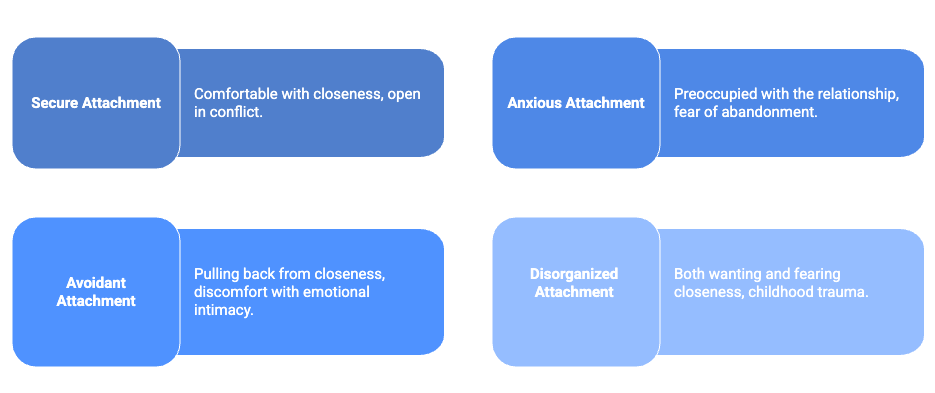
Comfortable with closeness, open in conflict: Secure attachment style means being able to seek closeness without panic and tolerate distance without collapse. People with a secure attachment style tend to feel at ease with emotional intimacy, communicate effectively, and trust that others will be available to them. Secure attachment style tends to support more stable relationships and better emotional closeness over time.
Preoccupied with the relationship: The anxious attachment style — sometimes called anxious ambivalent attachment — is characterized by a fear of abandonment, a need for constant reassurance, and an intense focus on whether the relationship is okay. People with anxious attachment often worry that romantic partners don't love them enough, even when evidence suggests otherwise.
Pulling back from closeness: The avoidant attachment style — sometimes called the dismissive attachment style — involves a strong pull toward self-sufficiency and discomfort with emotional closeness. People with avoidant attachment tend to avoid intimacy, minimize emotional needs, and display avoidant behaviors when relationships deepen. It can look like independence from the outside, but it's usually driven by a belief that depending on others isn't safe.
Both wanting and fearing closeness: The disorganized attachment style — also called fearful avoidant attachment style — combines elements of anxious and avoidant attachment. People with disorganized attachment both want closeness and fear it, often because their early attachment figure was also a source of fear or harm, such as in cases of childhood trauma or sexual abuse. A child's feelings of fear and love become intertwined in ways that make adult close relationships particularly complicated.
These four attachment styles are not personality types or life sentences. They are patterns. And patterns can change.
Can a Person Change Their Attachment Style?
Yes — attachment styles are moderately stable but meaningfully changeable across the lifespan. This is one of the most well-supported findings in adult attachment research, and it holds across naturalistic life experience, romantic relationships, and psychotherapy.
A comprehensive systematic review of attachment change during psychological therapy found that attachment security increases and attachment anxiety decreases following treatment — consistently across different patient groups, therapeutic approaches, and settings (Taylor et al., Psychotherapy Research, 2015). This held whether attachment was measured by clinical interview or self-report, and across both brief and longer-term treatments.
What Does Naturalistic Attachment Change Look Like?
Outside of therapy, change happens naturally too. A landmark longitudinal study following over 4,000 adults found that roughly a quarter of significant life events produced enduring changes in attachment styles — not just temporary shifts, but lasting revisions to how people related to others (Fraley et al., J Personality & Social Psychology, 2021). A separate 59-year longitudinal study found that attachment anxiety declined on average over the lifespan — particularly in middle adulthood — and that being in a romantic relationship predicted lower levels of both anxiety and avoidance over time (Chopik et al., J Personality & Social Psychology, 2019).
The term researchers use to describe people who began with insecure attachment but achieved secure functioning is earned secure attachment. A grounded theory study of adults who made this attachment style change identified three interrelated processes: developing self-awareness, processing past experiences, building a coherent narrative, learning to trust, and becoming comfortable with vulnerability — all supported by at least one consistently safe relationship (Dansby Olufowote et al., J Marital & Family Therapy, 2020).
From the Therapist
In our work with adults, one of the most common moments of relief we witness is when someone first learns about attachment styles and recognizes themselves in the description. Not because it solves anything — but because it replaces years of self-blame with a framework that actually fits. "I'm not broken, this is a pattern I learned" is often the first thing that has to shift before any real change becomes possible. That reframe alone can open a door that felt permanently closed.
Can You Heal Your Attachment Style?
Yes — and "heal" is actually a useful word here, because for many people, insecure attachment styles are rooted in genuine relational wounds from early childhood. The anxious attachment style often develops when a primary caregiver's inconsistent behavior left a child uncertain whether their emotional needs would be met. The avoidant attachment style often develops when expressing a child's feelings was met with dismissal or withdrawal, teaching self-sufficiency as a survival strategy. Disorganized attachment frequently develops when a child's life included fear of the very person who was supposed to provide safety.
Healing doesn't mean erasing those early experiences — it means building new relational experiences that update what the nervous system expects from close relationships. This is why social support and safe relationships are central to attachment change, not just formal therapy. Young adults and older adults alike can develop more secure attachment through a combination of self-awareness, therapeutic work, and meaningful relationships with securely attached people.
What Is the Hardest Attachment Style to Change?
Avoidant attachment — and particularly disorganized attachment — tends to be most resistant to change through relationship experience alone. Attachment research tracking change within established romantic couples over 20 months found that while attachment anxiety showed modest decreases, avoidant attachment remained stable regardless of relationship satisfaction, closeness, or support (Traut et al., J Personality & Social Psychology, 2025). This points toward targeted therapeutic intervention — rather than relationship experience alone — as the more reliable pathway for avoidant patterns specifically.
Disorganized attachment is considered the most clinically complex of the adult attachment styles because it involves simultaneous desires for and fears of closeness, often rooted in early trauma. People with disorganized attachment may find that both intimacy and distance feel threatening, creating push-pull dynamics in adult relationships that are hard to understand from the inside.
None of this means change is impossible. It means the pathway typically requires more than time or a good relationship — it usually benefits from working directly with underlying insecure patterns in a therapeutic context.
What Is the Hardest Attachment Style to Love?
Disorganized attachment is widely considered the most challenging attachment style to be in a relationship with — for both the person who has it and their partner. Because disorganized attachment involves both craving and fearing emotional closeness, partners can feel like they can never get it right: too much closeness triggers withdrawal, but distance triggers anxiety. The resulting push-pull dynamic is exhausting for everyone involved and often leads to significant relationship problems without outside support.
The avoidant attachment style can also be particularly difficult to love because avoidant behaviors — emotional unavailability, pulling back under stress, difficulty tolerating emotional intimacy — can feel like rejection even when that isn't the intent. Partners of people with avoidant attachment frequently report feeling shut out or like a complete stranger even in long-term intimate relationships.
That said, people with insecure attachment styles — including disorganized and avoidant attachment — are capable of deep, long lasting relationships. The key is that both people need to understand what is happening and be willing to work with it rather than against it.
What Attachment Style Has the Highest Divorce Rate?
Insecure attachment styles — particularly the combination of anxious and avoidant — are associated with lower relationship satisfaction and stability. The anxious and avoidant attachment dynamic tends to produce especially high relational distress: one partner seeking closeness and constant reassurance while the other withdraws, each activating the other's deepest fears and reinforcing the cycle.
Disorganized attachment is also strongly linked to relationship problems, given its roots in unresolved trauma and the inherent difficulty of tolerating emotional intimacy while also fearing it. By contrast, people with a secure attachment style tend to handle conflict better, manage conflict more openly, and maintain emotional connection under stress— which contributes to more stable relationships and better long-term relationship outcomes overall.
What Is the Rarest Attachment Style?
Disorganized attachment is generally the least common of the four attachment styles in the general population, though it appears at much higher rates in clinical populations — particularly among people with trauma histories or borderline personality disorder. Rates are substantially higher in individuals with histories of childhood trauma, neglect, or abuse than in low-risk community samples.
What Are Avoidants Like in Relationships?
People with an avoidant attachment style tend to prioritize self-sufficiency and can struggle to tolerate emotional intimacy even when they genuinely care about their partner. In romantic relationships, avoidant attachment typically shows up as emotional distancing under stress, difficulty expressing vulnerability, and discomfort with a partner who seeks too much emotional closeness. Avoidant behaviors are not a sign of not caring — they are the nervous system doing what it learned to do to stay safe.
What Are Avoidants Like in Bed?
In sexual and physical intimacy, people with avoidant attachment often find it easier to engage physically than emotionally. Sex can feel more manageable than emotional vulnerability, and some people with avoidant attachment styles report preferring physical closeness without the emotional closeness that comes with deeper relationship attachment. However, when a romantic partner begins to seek closeness or emotional connection through physical intimacy, avoidant responses — pulling back, becoming distant, or seeking more autonomy — can emerge. Understanding this pattern is part of what helps avoidant individuals and their partners work toward more secure attachment within intimate relationships.
What Are the Most Effective Ways to Change Your Attachment Style?
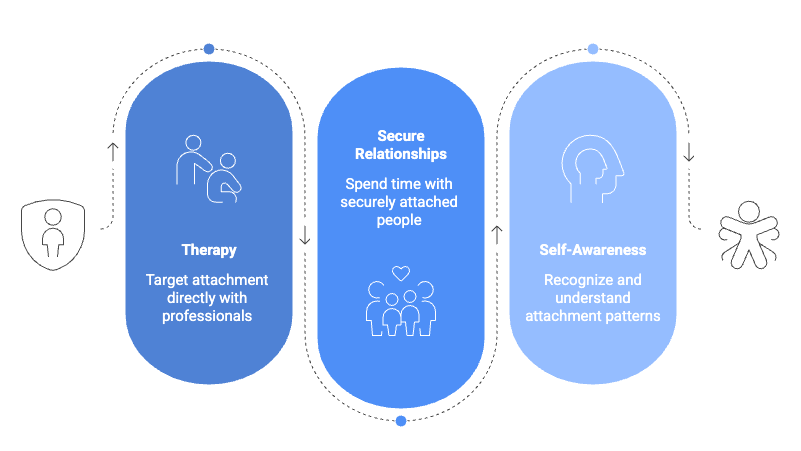
Therapy — Especially Approaches That Target Attachment Directly
Working with a therapist is the most reliably effective pathway for changing insecure attachment, particularly for avoidant and disorganized patterns. For many people, meeting with top therapists in Providence for individual therapy is a concrete way to begin this process. A meta-analysis of 32 studies found that improvement in attachment security during treatment predicted greater symptom improvement — leading authors to recommend that clinicians intervene directly to change attachment style as a proximal treatment goal (Levy et al., J Clinical Psychology, 2018).
Transference-focused psychotherapy (TFP) has the strongest RCT evidence for producing measurable changes in attachment classification. An RCT of 90 patients with borderline personality disorder found that those in TFP showed a significant increase in securely attached status after 12 months — an effect not seen in comparison treatments (Levy et al., J Consulting & Clinical Psychology, 2006).
Emotionally focused couple therapy (EFT) is highly effective for changing attachment patterns within romantic relationships. Many couples also find that premarital counseling with Gottman-trained therapists offers a structured way to strengthen communication and security before major commitments. A session-by-session study of couples found significant decreases in both attachment avoidance and attachment anxiety across EFT treatment, with these changes tied directly to increases in relationship satisfaction (Burgess Moser et al., J Marital & Family Therapy, 2016). EFT developer Sue Johnson has described the couple relationship itself as a vehicle for attachment change, positioning the secure base created in EFT as both the goal and the mechanism (Johnson, Current Opinion in Psychology, 2019).
CBT and other non-attachment-specific therapies can also produce attachment change, sometimes on a different timeline. An RCT of 495 patients with social anxiety disorder found that CBT produced significant changes in both attachment anxiety and avoidance — even though the treatment wasn't designed to target attachment directly (Strauß et al., PLoS One, 2018).
The therapeutic relationship itself matters enormously. Research suggests that therapy can function as a corrective attachment experience — providing the safe and secure base that allows clients to examine and revise the internal working models built in early childhood (Mikulincer et al., J Personality, 2013). Being reliably seen, heard, and responded to by a therapist — a consistent attachment figure who doesn't confirm fears about intimacy — appears to be one of the core mechanisms through which attachment styles change in treatment.
From the Therapist
We often tell clients that the therapeutic relationship isn't just the container for the work — it is the work. For many adults with insecure attachment styles, the experience of showing up week after week and finding a consistent, non-reactive presence on the other side is itself corrective. It's often the first time they've experienced a relationship that doesn't confirm their worst fears about intimacy. That repeated experience — not the insights alone — is what begins to move the needle on attachment.
Secure Relationships Outside of Therapy
Time in relationships with securely attached people can shift your own attachment patterns — though the evidence suggests this works more reliably for attachment anxiety than for avoidance. A 30-year prospective longitudinal study found that childhood friendship quality was a significant predictor of adult attachment avoidance — accounting for up to 10–11% of variance — suggesting that close relationships throughout the child's life and beyond continue to shape adult attachment styles (Dugan et al., J Personality & Social Psychology, 2025).
Being in a stable relationship with a securely attached partner creates ongoing opportunities to experience a safe and secure base, practice new ways of communicating, and gradually update the insecure patterns that drive anxious and avoidant behaviors. Group therapy designed to mirror real-life relationship dynamics can also offer a space to practice new ways of connecting. Social support from securely attached friends and family members also contributes to this process, expanding the relational evidence base that updates what the attachment system expects.
Self-Awareness and Self-Directed Change
Recognizing your attachment patterns is a genuine first step — not just a preliminary formality, but a meaningful part of the attachment process itself. Identifying your attachment style gives you a framework for understanding why certain situations trigger intense emotional reactions, and what past experiences may have taught you about relationships.
Concrete self-directed practices that support attachment style change include — and for many people, pairing these with flexible teletherapy options in Rhode Island provides additional support:
Practicing self-compassion — reducing harsh self-judgment and building the self-esteem needed to tolerate emotional closeness and emotional connection
Mindfulness and CBT techniques — noticing when your nervous system becomes activated by perceived relationship threats and developing the ability to self-soothe before reacting
Positive affirmations focused on worth and lovability, particularly for anxious attachment driven by fear of abandonment
Tracking triggers — identifying which interactions activate insecure attachment responses so you can bring conscious effort to those moments
Security priming — brief practices that activate secure attachment representations through visualization or imagery — shows promising results even outside formal therapy. A meta-analysis of 120 security priming studies found a large overall positive effect on affect, cognition, and behavior, with the largest effects among people higher in attachment insecurity (Gillath et al., Personality & Social Psychology Review, 2022).
What Does Changing Your Attachment Style Actually Look Like?
Attachment style change is gradual, non-linear, and rarely complete — not a switch that flips but a slow revision of deeply held beliefs about adult relationships. Attachment research using intensive longitudinal designs found that while attachment fluctuates week to week, people tend to return toward their characteristic level over time — a pattern called the "prototype model" (Fraley et al., J Personality & Social Psychology, 2011).
What Progress Actually Looks Like
In practice, this means you may have stretches of feeling securely attached — open, trusting, comfortable with emotional intimacy — and then get pulled back toward familiar anxious or avoidant behaviors under stress. That pull-back is not failure. It's how the attachment change process actually works. Progress looks like secure moments becoming more frequent, the pull-back becoming less intense, and recovery time shortening.
People who have successfully moved toward earned security typically describe both internal work — making sense of their past, building a coherent narrative — and relational experience — having at least one relationship where they felt safe enough to practice something different (Dansby Olufowote et al., J Marital & Family Therapy, 2020).
From the Therapist
We approach attachment change with a lot of patience — for our clients and for the process. One thing we've learned is that people often feel discouraged when they have a setback after a stretch of growth. We try to reframe that: the fact that you noticed the pull-back, named what was happening, and came back to talk about it is the progress. Attachment change isn't about eliminating insecure responses. It's about shortening the distance between activation and recovery.
Where to Start
Identify your attachment style. Self-awareness is the foundation of attachment style change. Notice your patterns in romantic relationships and close relationships — do you tend to seek constant reassurance, pull back when things get close, or feel both at once?
Consider therapy. Individual therapy and couples therapy are both effective pathways to attachment style change. A therapist who understands attachment theory and adult attachment styles can help you work through underlying childhood wounds and build new relational patterns.
Invest in secure relationships. Pay attention to the people in your life who feel consistently safe. More time in those relationships — and more willingness to let yourself be known in them — supports the attachment change process and builds the secure base that attachment research consistently identifies as central to earned security.
Practice self-compassion. Changing deep-rooted insecure attachment patterns takes time. Treating yourself with the same warmth you'd offer a close friend helps sustain the conscious effort required for lasting change.
If you're looking for support with attachment styles, relationship patterns, or the effects of early experiences on your adult life, the therapists at the Providence Therapy Group are here to help. Our team includes top therapists in Providence focused on relationship difficulties and emotional distress, as well as specialized perinatal therapists for pregnancy and postpartum challenges and clinicians trained in evidence-based OCD treatment like ERP and ACT. Schedule an appointment with a Providence therapist online or in person to get started. Schedule an appointment to get started.
Disclaimer: This article is for educational purposes only and is not a substitute for professional medical advice, diagnosis, or treatment. Always seek the advice of your physician or qualified mental health provider with any questions you may have regarding a medical or mental health condition. If you are in crisis or experiencing thoughts of self-harm, please call 988 (Suicide and Crisis Lifeline) or go to your nearest emergency room.